You are hereWells

Wells


Harpham

The drumming well located near to the church is reputed to foretell death in the family of St Quentin. The folklore relates to a story about a fourteenth century drummer called Tom Hewson, who was accidentally knocked down the well by a St Quentin squire. Read More »

Healing Wells at Healing

The village of Healing near Grimsby has two notable healing wells, though they are probably not the source of the villages name. In the Domesday Book, Healing is shown as being Hegelinge, an Anglo Saxon term, possibly similar to Hægelingas meaning ‘the sons or followers Hægel’. Read More »

Holy Island

The island was said to be the home of St Molaise who is reputed to have been born in Ireland in 570AD. He came to Holy Island to live as a hermit and Molaise's cave is one of his reputed abodes. Read More »

Holy Well of St Winifred

St Winifride's Holy Well

The healing waters of St Winifred’s (Winifride) Holy Well have attracted pilgrims for over 1300 years and the crypt in which the well lies was stacked with crutches left by the cured invalids until some time in the 1960’s, though can still be seen on display. Read More »

Llangelynin Church and The Holy Well of St. Celynin

Llangelynin church is one of the oldest and remotest churches in Wales; it dates from the 12th Century. Saint Celynin might have erected a religious edifice on the site in the 6th Century since St. Celynin’s well is in the corner of the church yard. The well is a small rectangular pool with stone seats and stone walls. It was reputedly famous for its ability to cure sick children. Read More »

Llddwyn Island

This island is connected by a sandy beach to Anglesey, and was home in the Dark Ages to a religious community, founded by the female Saint Dwynwen. St Dwynwen is a patron saint of Welsh lovers, and after her death the island became an important place of pilgrimage. Read More »

Loch Awe

Loch Awe is Scotlands third largest fresh water loch at with a length of 35km and total surface area of 14.9 miles. It shares a common legend about its creation which concerns a well that flooded. Read More »

Madron Holy Well

One of the most widely known wells in Cornwall, Madron Holy Well is still used, and has been the scene of some miraculous cures in the past. About 100 metres away are the remains of the Madron Well Chapel.

Rags and other objects are left to rot away in the hope of cures, and as votive offerings.

Directions: Northwest of Madron from a footpath Read More »

Maiden Well, North Kelsey

Maiden Well Lane in North Kelsey was probably named after the Maiden Well which was visited on St Mark’s Eve (April 24th) by unmarried women in order to discover, through divination who they will marry. Read More »

Mullinakill Holy Well

Mullenakill is just one of several places that claim to be the birth place of St Moling. Read More »

Nether Stowey

Nether Stowey has a number of holy wells, and the crossroads at Over Stowey is traditionally haunted by a creature known as the Galley Beggar, who laughs demonically at passers by. A Galley Begger is the local name for a frightening spirit.

New Books Published on Fairies and Boggles in Cumbria

A SERIES of hand-crafted booklets on the folklore and legends of Cumbria has been published. Read More »

Nine Maidens Well, Strathmartine

As with the dragon that was associated with it, very little remains of the Nine Maidens Well at Strathmartine, as the farmer upon whose land it could be found had the well covered up to stop it’s visitors from trampling his crops. Read More »

Penmon and Saint Seiriol

Penmon is a parish found on the south-east tip of Ynys Môn (the Isle of Anglesey). Things to see here include Penmon Priory, Saint Seiriol’s Church, Saint Seiriol’s Well, a dovecote and the Penmon crosses. Read More »

Pistyll Teilo

This pool and waterfall lie in a ravine below an old ruined curch dedicated to St Teilo (Capel Teilo). The water from the waterfall has long been thought to have healing properties, it was said to heal bruises and other ailments including rheumatism and sprains. All you had to do was hold the affected part in the main stream of icy water for a short while. Read More »

Schiehallion

The dark brooding presence of Schiehallion (pronounced She-hal-e-on)- the fairy hill of the Caledonians - looms over the Eastern end of Rannoch moor like a voluminous guardian. The mountain is one of the traditional haunts of otherworld beings. Read More »

St Aelhaearn’s Well

St Aelhaearn’s Well

This well can be found on the outskirts of the village of Llanaelhaearn, on the left hand side of the road as you ascend the (B4417) out of the village. It is enclosed in a locked stone structure which was constructed in 1900, and it is in front of a house called Bryn Iddon. Read More »

St Alkelda's Well, Middleham

St Alkeda was a chaste Saxon maiden, sometimes described as a princess, noble woman or a nun. On 28th March 800AD, somewhere close to the site of St Mary’s and St Alkelda’s Church, she was strangled to death for her faith by two Danish women involved in a Viking raid. It has been suggested that they killed her by twisting a napkin around her neck. Read More »

St Anthony's Well, Edinburgh

Prior to 1674 St Anthony’s Well flowed from beneath a small stone arch in a slightly higher position to the bolder from under which it now sprouts. It was probably connected to the nearby 15th century St Anthony’s Chapel which is now a ruin. Read More »

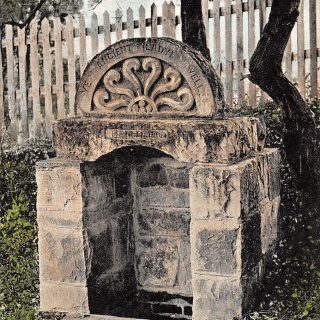
St Augustines Well, Cerne Abbas

St Augustines Well, Cerne Abbas

All the following details were made available on the information board inside the burial ground situated above St Augustine's Well; Read More »

St Canna's Stone (aka St Canna's Chair) & Fynnon Ganna (Canna's Holy Well)

St Canna (Born 510AD) founded churches at both Llangan and Llanganna, though she is thought to have maintained her residence at Llangan (Llang-gan) in Carmarthenshire (not to be confused with Llangan in the Vale of Glamorgan). It is here in Llangan that we find her church and records of a holy well and a cubical shaped stone inscribed with the name 'Carina' that were associated with the saint. Read More »

St Ethelbert’s Holy Well

Around 794AD, King Offa of Mercia demanded the head of the Christian King Ethelbert of East Anglia whilst he was making arrangements to marry Offa's daughter. Not far from the location of Marden Church the young king was assassinated and his body hidden. After rumours of Ethelbert's ghost being seen in the marden area, Offa asked the Pope for absolution. Read More »

St Fillan's Chair and Well Dunfillan

A rocky seat on top of the Dunfillan, is the place where St Fillan is said to have sat and blessed the surrounding lands. Read More »

St Keyne

St Keyne

The holy well in the village is connected with a 5th century virgin called St Keyne who performed miracles.

St Margaret's Well, Edinburgh

St Margaret's Well, Edinburgh

During the 1860 St Margaret's Well was moved to its present location from the crossroads between Holyrood and Restalrig. It was described in 1852 as 'a spring well, enclosed by an ancient vault over which part of the railway workshops had been built.' Read More »


Share/Save

Navigation

Recent comments

Book Review

Paranormal Stoke-on-Trent

Paranormal Stoke on Trent

"Paranormal Stoke-on-Trent" (History Press Ltd) is the new 96 page book detailing hauntings, myths and legends in and around the city of Stoke. It is the culmination of many years experience and research by Matt Hicks, along with Terri Setterington. Read More »

Featured Site