You are hereGreater London
Greater London
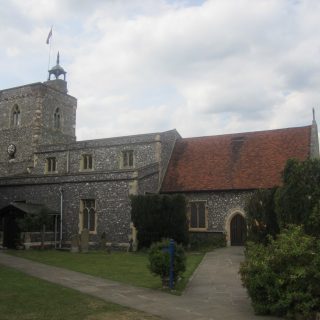
St Magnus the Martyr Church
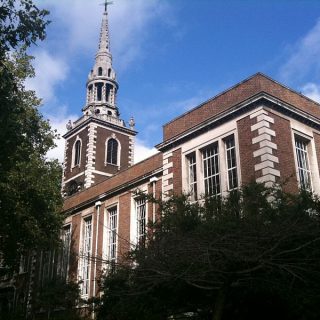
St Magnus the Martyr was the second church to be damaged during the Great Fire of London in 1666 and was subsequently rebuilt by Sir Christopher Wren (born 20 October 1632 – died 25 February 1723) at a cost of £9,580. Read More »
St Mary’s Church, Wanstead
The current St Mary’s dates from 1787 and is a Grade I listed building designed by Thomas Hardwick. The earlier church stood 70’ south of the present building and was demolished when the newer church was completed in 1790. The later church does have some monuments inside it that were originally from the older one and according to tradition it may have a few apparitions as well. Read More »
St Nicholas's Churchyard, Chiswick
St Nicholas’s Church on Church Street in Chiswick is reputedly haunted by two of Oliver Cromwell’s daughters and there is even a legend associated with the church suggesting that the Lord Protector himself may have finally found peace there. Read More »
Strange Mitcham by James Clark
Strange Mitcham by James Clark was first published as a booklet in 2002 as part of ASSAP's (Association for the Scientific Study of Anomalous Phenomena) Project Albion. It was updated and republished in 2011 giving James the opportunity to add a few more articles and further information. Read More »
Swains Lane
Dating from at least 1492 when it was referred to as Swayneslane, it was one of four old parallel pathways leading up to Highgate village. (The others being West Hill, Bromwich Walk (now disappeared) and Dartmouth Hill). Also known for a long time as Swines Lane, it passed between agricultural land giving access to the farms on either side of it. Read More »
Swearing on the Horns
Between the 17th and 19th centuries there was a folk custom in the Public Houses and Inns of Highgate known as the ‘Swearing on the Horns’. Read More »
Sydenham Black Panther
In March 2005 a large black cat attacked a Sydenham resident named Anthony Holder. The story of the incident appeared in the Daily Mail on 23 March 2005 in an article (featured below) by Sam Greenhill entitled ‘The night I was mauled by London's 'black panther’ Read More »
The Argyll Rooms
Argyll House (246 – 250 Regent Street) occupies the site where the Argyll Rooms once stood back before Regent Street was laid out. In 1830 during a concert recital at the Argyll Rooms a young woman saw an apparition which was recounted in the diary of the dandy merchant banker, Thomas Raikes (born 3 October 1777 – died 3 July 1848). Read More »
The Bedford Public House, Balham
The Bedford public house at 77 Bedford Hill dates back the 1830’s when it was originally opened as a hotel. Long known as a popular live music venue, it has even hosted early gigs by bands including U2 and The Clash. Read More »
The Bull, Shooters Hill
The Bull at 151 Shooter Hill dates from 1749 (though it was rebuilt in 1881) and it was a popular stopping place for coaches traveling along the route between London and Dover (Shooters Hill Road follows the route of the Roman Watling Street). Read More »
The Cauliflower, Ilford
The Cauliflower at 553 High Road, Ilford, is a popular live music venue and whilst Deryck Jones was the landlord it had a reputation of being haunted, with the case being written about in ‘The Publican’ and ‘The Haunted Pub Guide’ (Guy Lyon Playfair 1985). The date the Cauliflower was built is unknown, but in 1897 plans were made to make the pub into a hotel. Read More »
The City of London Cemetery
Opened in 1856, the 200 acre, Grade I listed City of London Cemetery is one of the largest municipal cemeteries in Europe and the final resting place for several famous people. During the 1970’s it was reported that a gravestone in the western portion of the cemetery glowed bright orange and no external light source or cause for this effect could be determined upon investigation. Read More »
The Connaught Tavern
Now known as The Fox@Connaught (since 2003), this pub dates from 1881 and is a Grade II listed building. Read More »
The Crown and Horseshoes, Enfield
The Crown and Horseshoes public house is an 18th century Grade II listed building and can be found on Horse Shoe Lane, by the canal. The Crown and Horseshoes has in the past had a reputation for being haunted. “Other than the footsteps and the mysterious banging of doors, nothing much happens these days”, Joan Forman told the author and investigator Andrew Green in 1976. Read More »
The Elms, Smithfield
Smithfield haled a fairly prominent place in medieval London. Not only was it the site of a famous market and a place where Royalty held their tournaments, the Elms at Smithfield was also well known as a place of execution and it is thought that some of those who were cruelly killed at this spot may haunt it still. Read More »
The Embassy Of Finland, London
The Embassy of Finland at 38 Chesham Place dates from around the 1830s. It was not of course always an Embassy and has over the years been known by various names such as Belgrave House and Herbert House. It is from an early time, possibly when it was a private residence that the reputed haunting of the Embassy has its roots. Read More »
The Flask Tavern
The Flask Tavern dates back to the 17th century and has served the likes of Karl Marx (born 5 May 1818 – died 14 March 1883), William Hogarth (born 10 November 1697 – died 26 October 1764) (painter) and Dick Turpin (born 1705 – died 7 April 1739) (highwayman) who is said to have been hidden there for a while. Read More »
The Gatehouse, Highgate
There were three main entrances each with a tollhouse leading into the Bishop of London’s Park of Haringeye and The Gatehouse was the tavern at the Highgate entrance. (The Spaniards Inn ,Newgate and East Finchley being the others). Read More »
The Grenadier, Knightsbridge
The Grenadier at 18 Wilton Row dates back to the early eighteenth century. Popular with Royalty and celebrities (King George IV, Madonna, Guy Ritchie and Gwyneth Paltrow) it was described by Guy Lyon Playfair in his Haunted Pub Guide (1987) as being “probably the most famous haunted pub in the world” and it is probably the one with its own sentry box outside. Read More »
The Highgate Vampire - How It All Began - by David Farrant
LONDON 1969, AND WIDE REPORTS WERE COMING INTO the British Psychic and Occult Society concerning a tall black apparition that had been seen lurking among the tombs of London's Highgate Cemetery. Most of these reports were from people who claimed to have been confronted by this apparition which invariably took the form of a tall dark figure and petrified people both in, or passing, the cemetery. Read More »
The Horns, Crucifix Lane
Suchards Bar & Thai Restaurant can now be found at 2 Crucifix Lane. Before Suchards it was known the Czar Bar and before that The Horns public house. The Horns dates back to the Victorian era and appears in the 1869 Post Office Directory, but it was in the mid 1960’s that it got a reputation of being haunted. Read More »
The John Snow, Soho
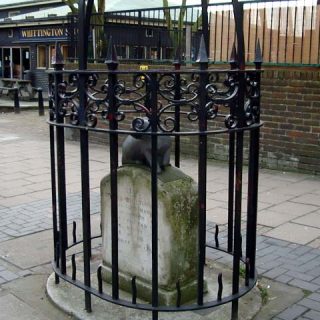
The John Snow public house at 39 Broadwick Street was named after Dr John Snow (Born 15 March 1813 – Died 16 June 1858), who traced the source of the Soho cholera outbreak of 31 August 1854 to contaminated water from a pump on Broadwick Street (known as Broad Street prior to 1936). Read More »
The Kings Arms, Peckham Rye
132 Peckham Rye was once the address of The King’s Arms public house, which was hit by a bomb during a World War II German air raid I which eleven people lost their lives. The pub was rebuilt and overtime eventually became a nightclub named Kings on the Rye before finally being demolished in the late 1990’s by a block of flats. Read More »
The London Stone
Mounted behind an iron grill in the wall of 111 Cannon Street (originally known as Candlewick Street) can be found what could be described as one of London’s most ancient monuments, The London Stone (also known as The Brutus stone). Read More »
The Nun of Covent Garden
Covent Garden (or Convent Garden) was a 40 acre area owned by the Abbey of Westminster that was used as a market garden in the Middle Ages. It was managed through the issuing of leases by the Abbot of Westminster until the Dissolution of the Monasteries by King Henry VII between 1536 and 1541, when it was taken by the state and eventually passed into the private ownership of the Earl of Bedford. Read More »