You are hereFolklore
Folklore
Danish Elf Midwife
According to ‘The Science of Fairy Tales’ (1891) by Edwin Sidney Hartland ‘A Danish tradition tells of a woman who was taken by an elf on Christmas Eve down into the earth to attend his wife. Read More »
Devil Conjuration In Merthyr Tydfil
Before Picton Street in Merthyr Tydfil was replaced by Caedraw Road, you could find the Black Lion Inn (58 Picton Street), and according to the following story which appeared in British Goblins (1881) by Wirt Sykes, two of its drunken customers attempted to summon the Devil which appeared to them in the shape of a gosling. 'These men were one night drinking together at the Black Lion Inn, when Read More »
Devil In Risca
According to British Goblins (1881) by Wirt Sykes; 'To William Jones, a sabbath-breaker, of Risca village, the devil appeared as an enormous mastiff dog, which transformed itself into a great fire and made a roaring noise like burning gorse'.
Devil Summoning Tailor of Glanbran
The 18th century Glanbran House was dismantled around 1930 and was the ancestral home of the Gwynne family, the descendants of David Goch Gwyn who settled at Glanbran in the 16th century. Wirt Sykes in his British Goblins: Welsh Folk-Lore, Fairy Mythology, Legends and Traditions (1881) gives the following story in which an unnamed member of the Gwynne family plays a prominent part. Read More »
The Devil's Stone, Shebbear
The stone that lies in the village square to the East of the church is turned every year on November the 5th by local people. The stone is made from a type of quartz not found in the area, measures about six feet by four feet and weighs about a ton. Read More »
Dobbin
Dobbin were lazy creatures who would attach themselves to a particular farm. In times of trouble they sometimes exerted themselves on behalf of the family.
[The Folklore Of Warwickshire (1976) by Roy Palmer]
The Dobhar-chu
The Dobhar-chu or water hound is a lake dwelling creature of Irish Folklore. It is covered in short white fur with a dark cross on it’s back and described as being like a dog or a large sea otter. Read More »
Dobhar-chú of Lough Mask
The following account of a Dobhar-chú in Lough Mask (Lake Mask) appeared in Roderic O’Flaherty’s (1629 – 1718) ‘A Description of West Connaught’ dated 1684 which was translated by James Hardiman in 1846. Read More »
Doon Hill and Robert Kirk
Doon Hill and the Old Kirk in Aberfoyle, will forever be associated with the Reverend Robert Kirk, who wrote the Secret Commonwealth in 1691. The book is an essay on the nature and social structure of supernatural beings or fairies. Robert was a seventh son, said to have been gifted with second sight. Read More »
The Dream of Maxen Wledig
The Dream of Maxen Wledig is one of the Medieval Welsh tales translated by Lady Charlotte Guest, which were published collectively as the Mabinogion in 1849. The story is rooted in a mythic interpretation of the twilight of Roman era in Britain. Read More »
Drum Hill, Fuzhou
Drum Hill can be found on the northern bank of the Minjiang River, in the eastern suburbs of Fuzhou, Fujian Province. It is thought that it gets its name from a huge boulder, shaped like a drum that sits on the summit of the hill. Read More »
Drum Hill, Little Eaton
There is apparently a legend (or maybe it’s camp fire ghost story) associated with Drum Hill, which is situated on the edge of Little Eaton, although it has undoubtedly been kept alive (and most probably elaborated) by the Scouts and Guides who regularly use the site as a camping ground. Read More »
Dun Borranish
This ruined dun is said to have been the home of a giant called Cuithach, who in the tradition of most giants, laid waste to the surrounding area by stealing cattle and killing local people. Read More »
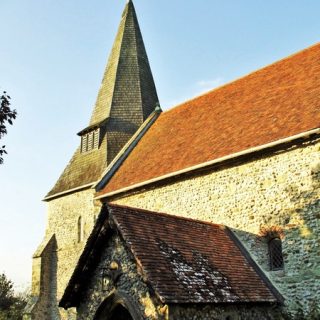
Dunino Church and Den
The church may occupy a site on which a stone circle once stood, some of the stones can still be seen incorporated into the fabric of the church. In other stories the stones came from a circle on the other side of Dunino Den. It was quite common for churches to be built on much older pagan sites. Read More »
Dylife Lead Mine
Dylife was a small lead mining community which was totally abandoned when the mine closed at the end of the 1800’s. Read More »
Each Uisge
The Each Uisge, is a name for the Highland supernatural water horse, supposedly the most dangerous of the Scottish water dwelling creatures. The monster inhabited the sea, sea lochs and fresh water lochs and is sometimes mistaken in writing as the Kelpie, which is supposed to inhabit rivers and streams. Read More »
Earth Dogs
A mythical creature that may be confined to one area of Banffshire in Scotland, according to Walter Grigor in his ‘Notes on the folklore of NE Scotland’ published in 1881, the Yird Swine were a “dreaded ..animal” that lived in graveyards and burrowed through the earth feeding on the dead bodies. Read More »
Earthman And The Midwife
In The Science of Fairy Tales (1891), Edwin Sidney Hartland gives the following account of a Swabian* story where a human midwife is called to aid an Earthman’s wife (a name given to this type of fairy) give birth. Read More »
Eastbury House
The remains of this once grand house has a reputation of being haunted and associated with a vampire legend. The property is private and you cannot gain access but the story of Eastbury House and its past owners is certainly interesting. Read More »
Edin's Hall Broch
This is one of the most southerly broch survivals, which are more typically associated with Northern Scotland. Broch’s were multi floored defensive structures with room for cattle in the lower enclosure and accommodation on the upper floors accessed by passageways in the thick walls. Read More »
The Elder Mother, Elder Tree
In Danish folk belief every Elder Tree is inhabited and protected by a female spirit known as the Hyldemoer, and is revered as a sacred tree. This tradition may have some parallels in Britain, as I heard a similar folk belief when I was growing up in England. I was told that the tree was guarded by a female spirit and it was unlucky to bring the wood into the house. Read More »
Eldon Hole
Known as one of the wonders of the Peak, Eldon Hole was once thought to be a bottomless refuge for the Devil. Folklore suggests that a man called Charles Cotton was lowered down the hole in the past on a rope a mile long and still didn't reach the bottom.
Another man was lowered down and found to be unconscious when he was raised, he died soon afterwards. Read More »
Elidor and The Golden Ball
This story was first collected by the medieval chronicler Geraldus Cambrensis, and tells of how a young boy lived for a time in the fairy kingdon, until the day he tried to steal one of their belongings. This version is from Joseph Jacob's More Celtic Fairy Tales, 1892. Read More »
Ellylldan
A Welsh spirit similar to the English Will o' the Wisp, it appears as a light and misleads travellers from their path.
Along with black dogs, tales of fairy lights are common throughout Britain, with a different name given to a similar phenomena. In general they are seen as malevolent, guiding lone travellers into treacherous bogs. Read More »
Ellyllon
According to 'British Goblins' (1881) by Wirt Sykes; 'The Ellyllon are the pigmy elves who haunt the groves and valleys, and correspond pretty closely with the English elves. Read More »