You are hereLegends
Legends
Beast of Lettir Dallan
The Triads of Ireland or the Trecheng Breth Féne describe the Beast of Lettir Dallan as one of the three wonders of Glenn Dallan in Tirowen. Read More »
Bedd Arthur
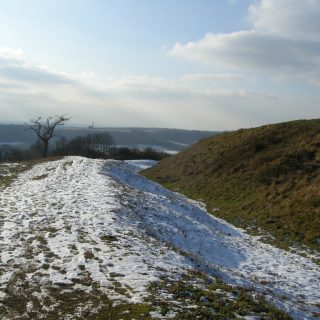
The whole area around Dyfed is associated with Arthur, outlined in the old Welsh tales now part of the Mabinogion. This cairn on the hilltop is thought to be Arthur's Grave.
Directions: The grave is in the Prescely Mountains
Bedd-yr-Afanc
Bedd-yr-Afanc means the monsters grave, the Afanc being a name commonly given to a water monster in Wales. The grave is actually the only Bronze Age Gallery Grave in Wales and dates from around 1500BC. Just two rows of parallel stones survive. According to legend the Afanc used to dwell in a pool by Brynberian Bridge, and was captured and killed then buried in this mound on the hillside. Read More »
Ben Bulben
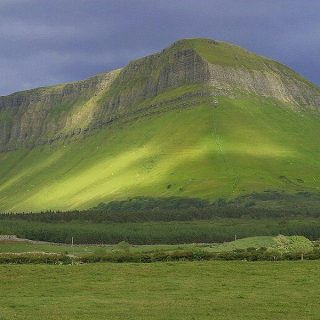
Legendary home of the Irish third century warriors known as the Fianna, Ben Bulben (or Benbulben, Benbulbin, Binn Ghulbain) is a large glacial rock formation in the Darty Mountains. Read More »
Bhangarh
The ruins of Bhangarh fort and city are in Alwar district, Rajasthan, India and is roughly 80kms from Alwar City. It has been called the most haunted place in India and staying in the ruins after dark is strictly prohibited by the government. Read More »
Birdoswald Roman Fort
This impressive site is the remains of a Roman fort on Hadrian's Wall. The area was occupied from much earlier times and recently a Neolithic burial has been found. There is also evidence of a large Dark Age Hall on the site. Traditionally the site has been identified with Camlan, the site of King Arthur's last battle. Read More »
Black Calf Of Narberth
Wirt Sykes in his British Goblins (1881) tells us of what may have been the ghost of an animal or as those in the North of England may refer to as a hairy ghost. However, this one, according to Sykes may have been something more sinister. Read More »
The Legend of Bladud
Bladud was the legendary founder of Bath and the sacred temple of Aqua Sullis. He is mentioned in Geoffrey of Monmouth's History of the Kings of Britain and The Life of Merlin, written in the twelfth century. The source of the original legend is obscure. Read More »
Bleeding Heart Yard and Lady Elizabeth Hatton
There is a Devil legend associated with Bleeding Heart Yard that ends in the horrific death of Lady Elizabeth Hatton. The scene of the legend is a grand ball at Hatton House on 26 January 1626 (though sometimes shown as 1662). Lady Hatton attracted a lot of attention as she danced throughout the night being both a young beauty and very wealthy. Read More »
Blencathra Mountain (The Saddleback)
This mountain is one of the locations associated with an army of sleeping knights, this time King Arthur and his men, waiting for the call to arms when he is most needed. In old Cumbrian, Blencathra means 'Devils Peak'
Directions: A footpath leads to the hill from Blencathra Centre. Read More »
Blue Ben of Kilve
A dragon called Blue Ben resided here and was supposedly the steed of the devil. He fell from a causeway of rocks and drowned in the mud. His skull (actually a fossil Ichthyosaur) was uncovered and is on display in the local museum.
The above was taken from an article by Richard Freeman.
Blue Stane, St Andrews
The Blue Stane (stone) now largely ignored, was once a Celtic place of power in the landscape around St Andrews. Read More »
Bodewryd Standing Stone (a.k.a. Carreglefn, Maen Pres)
The Bodewryd standing stone is approximately between eleven and twelve feet tall, and stands alone in a field on the Plas Bodewryd Estate. It is also known as Carreglefn (Smooth Stone), and as Maen Pres (Brass Stone). Read More »
Bolster and St Agnes
In the time of giants in the Penwith area of Cornwall, there lived a particularly troublesome giant called Bolster, who was of such enormous stature that he could stand with one foot on Carn Brae, and the other on the beacon near St Agnes, a distance of 6 miles. Read More »
Bosherton Lake
The local lake is said to have been the body of water into which Arthur's sword Excalibur was cast after the battle of Cammlan.
Directions: A footpath from Bosherton leads to the lake Bosherton reached off the B4319 South of Pembroke
The Brahan Seer
The Brahan Seer is undoubtedly the most famous of all Celtic seers although the reality of the 17th Century Coinneach Odhar Fiosaiche or Kenneth Mackenzie is hidden deep in legend. The roots of these legends may have come from a holy man in the 1600’s, about whom legends have grown with the years. Read More »
Brent Knoll
The hill, which was once and Iron Age hillfort, is associated with an Arthurian Legend, and was the abode of three fearsome giants. Read More »
Brent Pelham and Piers Shonks
‘A mighty dragon made its lair under the roots of an ancient yew tree and wrought havoc in the surrounding countryside. Piers Shonks, Lord of the Manor of Pelham, fought it accompanied by three huge hounds. He finally triumphed by thrusting a long spear down the dragon’s throat. Read More »
British Dragon Gazetteer
No other country on earth has such rich dragon lore as the British Isles. Our tiny little homeland is crawling with legends of these beasts. If you have ever wondered if there is a dragon legend close to where you live, then take a look at the following list. Read More »
Bryn Myrddin (Merlin's Hill)
The hill is one of many places in Britain reputed to be the prison of Merlin, where Merlin lies asleep in a cave awaiting the call to return and help his fellow countrymen. According to tradition it is possible to hear his groans from under the hill if you listen hard enough. In legend Merlin was born in Carmarthen 2 miles away from the hill. Read More »
Burning of the Bartle, West Witton
Famous for the Burning of the Bartle festival, when an effigy of St Bartholomew is burned in the town. The festival takes place on the nearest Saturday to the 24th of August. Read More »
Burrafirth
Two Norse giants lived on the Isle of Unst, which is the most northerly of the Shetland Islands. One giant was called Herman and his rival was Saxi (Saxa). Read More »
Byard's Leap
Black Meg was a man-eating ogress who lived in a cave on the wild and lonely expanse of Ancaster Heath. She terrorised the countryside for miles around, devouring anyone she came across. Her foul, evil spells made the land barren and she used her long iron claws to maul and kill livestock. Read More »
Cadbury Castle
This large hillfort has a plethora of traditions attached to it, most notably that it is the site of the legendary Camelot, the stronghold of Arthur. There is a distinct possibility that the historical Arthur - probably a sixth century war leader - had his base here, as the Iron Age hillfort was reoccupied and refortified around this time. Read More »
Cader Idris
This holy mountain has a rock seat called 'The Seat of Prince Idris'. It is said that anyone who spends the night alone on the mountain will either die, become insane or become a poet.
The seat of Prince Idris is also known as the Chair of Idris, and was named after a giant who was said to view the heavens from this lofty point. Read More »