You are hereLegends
Legends
The Lady in the Mask
The story was all over the news. A beautiful young woman, married only a few months had been suffering terribly at the hands of her husband. He was an aggressive drunkard and during one of his fits of temper he had cut both of her cheeks, ear to ear, with a pair of scissors. Read More »
The Lady Of The Fountain
The Lady Of The Fountain is one the tales in the Mabinogion. This English translation by Lady Charlotte Guest was published in 1877. Read More »
The London Stone
Mounted behind an iron grill in the wall of 111 Cannon Street (originally known as Candlewick Street) can be found what could be described as one of London’s most ancient monuments, The London Stone (also known as The Brutus stone). Read More »
The Newgate Calendar Part 1: Sawney Bean
An extract from The Newgate Calendar Part 1 concerning Sawney Bean. Read More »
The Parish Church of St Michael, Cornhill
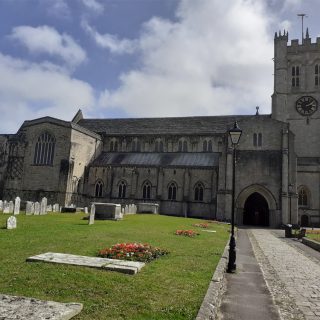
St Michaels’ Church in Cornhill is a Grade I listed building, built by Sir Christopher Wren between 1699 and 1672 following the destruction of the earlier medieval church in the Great Fire of London. It was in this now lost medieval building that according to legend a creature was encountered by the bell ringers early in the first half of the sixteenth century. Read More »
The Rufus Stone
The Rufus stone (now encased in metal) erected by Earl De La Warr in 1745, marks the location where King William II of England (referred to as William Rufus due to his red faced complexion) died in a hunting accident on 2 August 1100. Some mystery still envelopes the events of his death. Read More »
The Slingsby Serpent
In 1619 the antiquary Roger Dodsworth (born 1585 – died 1654) gave an early account of the dragon: ‘The tradition is that between Malton and this town there was some time a serpent, that lived upon prey of passengers, and which this Wyvill and his dog did kill, when he received his death-wound. Read More »
The Thirteen Treasures of the Island of Britain
These treasures are ancient magical items of Welsh tradition that are mentioned in 15th and 16th Century manuscripts. Most of the treasures are from and in ‘The North’ of the Island of Britain. Read More »
The Three Crutches, Strood
One night in the 13th century a Templar Knight named Sir Richard or Reginald Braybrooke was murdered whilst travelling (probably) to Temple Manor after visiting Lord Cobham. He was shot through the heart by and arrow and his body was not discovered until the following day at a location where three roads met. The murderer was never caught or brought to justice. Read More »
The Treasure of Craig-y-Ddinas
The Rock of the Fortress, was a hillfort during the Iron Age period, it is supposed to have been one of the last place the fairies lived in Britain. The following legend conforms to a folklore motif found throughout the country, namely that of sleeping warriors under hollow hills. Read More »
The Treasure of Largo Law
The area around Largo Law is associated with many legends. The actual hill of Largo Law is volcanic in origin, and was said to have been created when the Devil dropped a huge boulder. Part of the outcrop on the top of Largo Law is known as the Devil's chair, and has seven steps leading up to it. Read More »
The Well Of The Holy Rood, Stenton
The 16th century Well of the Holy Rood at Stenton has a legend attached to its finial which resembles a rosetted cardinal's hat. The legend states that the tenure of Beil depends upon the well keeping its hat. Read More »
The Whetstone of Tudwal Tudglyd
The Whetstone of Tudwal Tudglyd is one of the Thirteen Treasures of Britain. It would magically enhance the sword of a brave man should he sharpen it with this whetstone, enabling the sword to draw the very life out of any man wounded by the weapon. Read More »
The Wise Woman Of Littondale
The following legend of 'The Wise Woman Of Littondale' appeared in 'The Table Book' (1827) by William Hone (Born 3 June 1780 – Died 8 November 1842) and partially reprinted in ‘Yorkshire Legends and Traditions’ by Rev Thomas Parkinson (1888). Read More »
The Worm Of Sexhow
The Worm of Sexhow, according to ‘Yorkshire Legends and Traditions’ by Rev Thomas Parkinson (1888): ’Sexhow is a small hamlet or township in the parish of Rudby, some four miles from the town of Stokesley, in Cleveland. Upon a round knoll at this place a most pestilent dragon, or worm, took up its abode; whence it came, or what was its origin, no one knew. Read More »
Thomas Holt And The Devil
Roy Palmer in 'The Folklore Of Warwickshire (1976)' tells us that 'A Coventry musician, called Thomas Holt, who had nineteen children, sold himself to the devil to solve his financial problems. Read More »
Tre'r Ceiri (Town of Fortresses)
To the North of Pwllheli, between the main road from Llanaelhaearn to Llithfaen, and the coast, are three peaks known as ‘the Rivals’ in English and ‘Yr Eifl’ in Welsh. Upon the eastern peak is an Iron Age hill fort called Tre’r Ceiri which is regarded by many as the most important prehistoric town in North Wales if not the whole of Europe. Read More »
Trethevy Quoit or King Arthur's Quoit
Trevethy Quoit, also known as King Arthur's Quoit, is one of the more impressive burial chambers in Cornwall. Standing at over 15 feet 4.6 Metres. This cromlech dates from the Bronze Age period. The capstone is pierced by a hole, the purpose of which is unknown. Read More »
Uffington White Horse and Dragon Hill
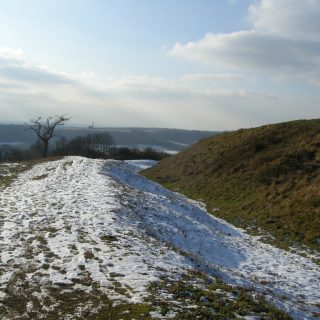
The White Horse of Uffington is one of the most impressive sites close to the ancient Ridgeway path, which traverses the steep chalk downs brooding over the Vale of the White Horse. Other sites include Dragon Hill, The Manger and Uffington Castle, which have been the subject of legend and folklore for over a thousand years. Read More »
Unsworth Dragon
According to ‘Lancashire Legends’ (1873) by John Harland & T T Wilkinson, ‘One of the most noted dragon stories of Lancashire has its locality assigned to Unsworth, a small village or hamlet about three miles from Bury. Read More »
Upper Denton
The local church made from the distinctive stones taken from Hadrian's Wall dates back to Saxon times. The churchyard holds the grave of Margaret Teasdale who died aged ninety-eight in 1777. Items found in her home after her death led the locals to believe she had an interest in the occult and she has been regarded as a witch since then.
Upsall
Upsall is associated with a common tale: A man from the village dreamed for three consecutive nights that he should go to London and stand on London Bridge. Conceding to impulse he went to London and while on the bridge he was approached by a Quaker, to whom he told his dream. Read More »
Vayne Castle
The ruin of the Z-plan Vayne Castle dates from the 16th century was built by the Lindsays. There is a Devil legend associated with the castle according to 'The History and Traditions of the Land of the Lindsays' (1882), which states that: Read More »
Veryan
Five circular thatched houses, within the village are supposed to have been designed to ensure that the Devil cannot hide in any corners. Each house is topped with a cross, a further deterrent to the Devil. In actuality they were built by the Reverend Jeremiah Trist for his daughters. The houses are now in private ownership. Read More »
Wade and his Wife
Wade and his wife were two giants, said to have lived in the area around Whitby in North Yorkshire. As part of the old race they both had the most tremendous powers, and could lift mountains and throw giant boulders like pebbles. Read More »