You are hereWales
Wales
Caerleon Amphitheatre
This is the best example of a Roman amphitheatre in Britain. Until 1926 when serious excavations were undertaken at the site, it was considered to be a circular earthwork and linked to the legend of King Arthur being known as his Round Table. Read More »
Capel Garmon Burial Chamber
Located to the south of the village of Capel Garmon, signposted and in a farmer’s field, are the remains of an ancient Neolithic chambered cairn. It is estimated that the ruins are around 5,000 years old, and it was excavated sometime between 1925 and 1927. It has a curved passage approximately fifteen feet long and four feet high, and two circular burial chambers to the east and west. Read More »
Capel Garmon Church
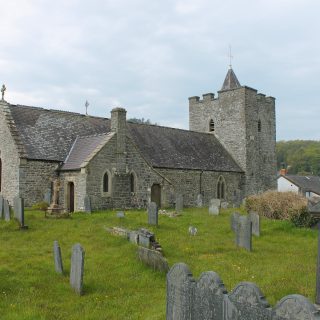
There have been a series of churches in Capel Garmon, the latest of which is the now closed, this being St Garmon's Church that was built in 1862. In his 'Welsh folk-lore' (1887) Elias Owen recounts the following legend he heard pertaining to the church in Capel Garmon from his friend Rev. Owen Jones of Pentrevoelas. Read More »
Capel Lligwy
The remains of this building, close to Din Lligwy and the Lligwy cromlech can cause the visitor to stop and ponder why a chapel was built in this isolated evocative position overlooking L Read More »
Capel Salem
Built in 1850, this Baptist Chapel was made famous by the Devon artist Sydney Curnow Vosper (29 October 1866 – 10 July 1942) in 1908, when he painted a member of the congregation in traditional Welsh costume. Read More »
Cardiff Castle
This site has been used for military installations since 55AD when the first Roman fort was built upon it during the pacification of the Silures Tribe. Read More »
Carn March Arthur
A rock overlooking the Dovey Estuary, on a hill above the A493, bears a depression that is said to be the hoofprint of Arthur's horse.
Directions: The rock lies above the A493.
Carneddau Hengwm
The Carneddau Hengwm are a couple of quite large tumuli or Neolithic burial chambers that are about two and half miles inland from Llanaber off the A496 Meirionnydd coastal road between Barmouth and Harlech. They lie in an East to West alignment, about fifty yards apart and at an altitude of 900 feet. Read More »
Carreg Arthur (Arthur’s Rock)
Carreg Arthur is the name given to a hefty volcanic boulder estimated to be about 450 million years old that stands in a scenic area of North Wales to the south of Llanrug. Read More »
Carreg Cennen Castle
The ruined castle has a wishing well, which had the ability to heal eye and ear disorders. The well is reached via an underground tunnel that leads to a cave. Traditionally one had to leave a pin in its waters and then make the wish. Prehistoric skeletons have also been uncovered from within this cave, and it is likely that it was used in ancient times as a place of reverence. Read More »
Carreg Standing Stone a.k.a. Moel Goedog Stone 8 a.k.a. Fonlief Hir Stone B
Carreg is the second tallest stone of the Fonlief Hir ancient track way. It stands 1.8 metres high and found standing in a field beside the road.
Castell Bryn Gwyn
There is much speculation over the age and use of Castell Bryn Gwyn (White Hill Castle). It was not a hillfort, being built on flat land, but excavations in 1959-1960 discovered that the rampart and ditch were similar to hillfort defences. It may have been a Neolithic henge monument, but nevertheless, there has been a long history of occupation at the site. Read More »
Castell Caer Lleion (Seion)
Castle Caer Lleion, located at the peak of Conwy Mountian (Mynydd-Y-Dref), (at an elevation of 244 metres) to the east of Conwy, is a noteworthy and easily accessible Iron Age hill fort which has spectacular views of the North Wales coast line and the Carneddau Mountains. Read More »
Castell Odo
The late Bronze Age hillfort of Castell Odo on the Lleyn peninsula is one of the most important archaeological sites in Wales. It is situated on the summit of Mynydd Ystum and was probably built and colonised by Celtic settlers coming from the Irish Sea in around 400 BC. Read More »
Castell Tomen-y-Mur, (a.k.a. Mur-y-Castell and Heriri Mons)
Tomen-y-Mur (translated as ‘Mound in the Walls’) was originally an ancient Roman fort on the slope of Mynydd Maentwrog to the north east of Llyn Trawsfynyedd, with access from A470 although it is not signposted. Read More »
Castell-y-Bere
Close to Llanfihangel-y-pennant is the native Welsh castle known as Castell-y-Bere. Constructed from stone, on top of a rocky hillock that overlooks the Dysynni Valley it was once the largest and most richly ornamented castles in Wales. Llywelyn ap Iorwerth, a.k.a. Llywelyn the Great (c. Read More »
Cefn Cave Crocodile
There is a tradition that a local man found a crocodile in Cefn Caves, which was a popular visitor attraction. This supposedly occurred near the end of the nineteenth century (approx 1870) and upon discovering the creature he managed to kill it. Read More »
Changelings
Changelings are part of Western Folklore, a child of a fairy type (Elf, Troll etc) which has been secretly swapped for a human baby and left in its place. George Waldron gave the following description of one he saw in the Isle of Man and it was subsequently reprinted in ‘The Science of Fairy Tales’ (1891) by Edwin Sidney Hartland. Read More »
Church of St Mor and St Deiniol, Llanfor
The Grade II listed listed of Church of St Mor and St Deiniol in Llanfor is no longer a place of worship and has been recently been advertised for sale. Built in 1875 on the site of a much older building, possibly the oldest church in Merioneth. It is possible that this older church was reputed to have been haunted. Read More »
Clegyr Boia
This rocky hilltop was occupied during the Neolithic period around 3800BC, when there were a number of rectangular houses on the summit. During the Iron Age the hill was fortified and served as a hillfort. A rampart, which can still be seen today, was completed around the hill with an entrance towards the Southwest. Read More »
Clogwyn Arllef Hillfort
On the summit of an isolated ridge in the parish of Llanbedr stand the remains of the prehistoric hillfort known as Clogwyn Arllef. The dimensions are roughly 70 metres in diameter from north to south, and 55 metres form west to east. The remains are defined by fallen stone wall which is an average of 2 metres wide.
Coed-y-Bleiddiau (Forest of the Wolves)
The Coed-y-Bleiddiau was once ancient woodland where it is said that the last wolf in Wales was allegedly killed. There is now another living wolf in woodland, but it’s safe because it’s made form of a living willow sculpture.
Conwy & Conwy Bay
In legend a curse was put upon the town and its entire people by a mermaid hundreds of years ago. She was found stranded on the rocks at low tide by local fishermen, who would not return her to the water no matter how much she begged. She cursed the town saying that the people would always be poor. The curse is now said to have run its course. Read More »
Conwy Castle
Conwy castle and the city walls were built from the years 1283-1289 by approximately 1,500 workers at the height of the construction, to form one of King Edward I (17th June 1239 – 7th July 1307) fortresses in his ‘Ring of Castles’, used to quell the Welsh uprisings. English citizens were moved in to the town and the Welsh people were banned from living there. Read More »
Cors-y-Gedol Burial Chamber
The Cors-y-Gedol burial chamber which still has it's capstone intact is also referred to as Arthur’s Quoit and can be found close to some ancient hut circles known as the Irishmen’s huts on the slope of Moelfre. Read More »