Llangadock
Elliott O’Donnell gives the following description of a submerged town near Llangadock in his 1939 book ‘Haunted Churches’.

Folklore / Folktales / Welsh Folktales
by Ian · Published April 9, 2016 · Last modified January 1, 2019
Elliott O’Donnell gives the following description of a submerged town near Llangadock in his 1939 book ‘Haunted Churches’.

Folklore / Folktales / Welsh Folktales
by Ian · Published June 22, 2015 · Last modified December 9, 2018
The following story entitled ‘The Roaring Bull of Bagbury’ was published in ‘English Fairy and Other Folk Tales’ (1890) by Edwin Sidney Hartland.
Fairies / Folklore / Folktales / Welsh Fairies / Welsh Folktales
by Ian · Published August 9, 2013 · Last modified December 9, 2018
Trichrug or Pen-y-bicws is a hill in the Brecon Beacons standing 415m in height. It is associated with both a stone throwing giant and local fairies.
Folklore / Folktales / Welsh Folktales
by Ian · Published August 4, 2013 · Last modified November 22, 2018
A famous Welsh witch, who used to sleep under stone at Llanberis, in North Wales, was called Canrig Bwt, and her favourite dish at dinner- was children’s brains. A certain criminal who had received a death-sentence was given the alternative of attacking this frightful creature, his life to be spared should he succeed in destroying her.
Early Christianity / Folklore / Folktales / King Arthur / Legends / Welsh Folktales
by Ian · Published August 3, 2013 · Last modified November 23, 2018
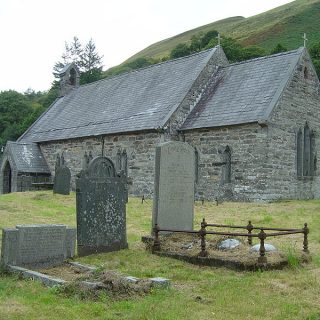
In the village of Llanymawddwy, there is an ancient church dedicated to St. Tydecho, thought to be the son of Anna Pendragon, King Arthur’s sister. Wirt Sykes in British Goblins (1881) gives the following tale of St. Tydecho and a blue stone. ‘There was a stone in the valley of Mowddwy, which did good service for the church. A certain St.
Folklore / Folktales / Welsh Folktales
by Ian · Published August 2, 2013 · Last modified December 9, 2018
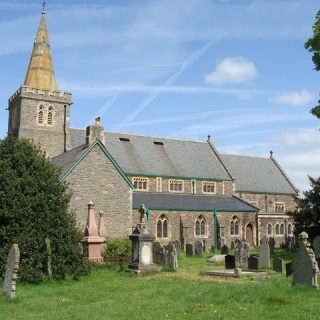
The Grade II listed Church of St David in Llanfaes dates from 1923-25. This church replaced an earlier one built in 1859. It has been suggested that this Victorian St David’s that was constructed by J Clayton, was built beside the remains of an earlier medieval church. The church at Llanfaes has been recorded as early as 1291 in the ‘Ecclesia de Lanmays’.
Ancient Sites / Early Christianity / Folklore / Folktales / Merlin / Welsh Folktales
by Ian · Published July 29, 2013 · Last modified January 1, 2019
Llech Lafar, a speaking slab of marble by the River Alun is referred to by Wirt Sykes in his ‘British Goblins’ (1881). ‘The Talking Stone Llechlafar, or stone of loquacity, served as a bridge over the river Alyn, bounding the churchyard of St. David s in Pembrokeshire, on the northern side.
Fairies / Folklore / Folktales / Welsh Fairies / Welsh Folktales
by Ian · Published November 19, 2012 · Last modified November 22, 2018
In ‘The Science of Fairy Tales’ (1891), Edwin Sidney Hartland mentions the following story from Beddgelert where a stolen fairy lady ‘would only consent to be the servant of her ravisher if he could find out her name.
Fairies / Folklore / Folktales / Welsh Fairies / Welsh Folktales
by Ian · Published November 12, 2012 · Last modified November 21, 2018
Y Dolydd is a long vacated, derelict cottage with an interesting Tylwyth Teg (Welsh Fairy) legend associated with it. Many years ago the cottage was the residence to a poor young widow, who one day encountered a charismatic Tylwyth Teg who asked her to bring up a child for him. The widow agreed to this, and several days later she found a beautiful baby boy on her doorstep.
Fairies / Folklore / Folktales / Welsh Fairies / Welsh Folktales
by Ian · Published November 12, 2012 · Last modified November 23, 2018
The Beaver Pool can be found about a mile to the south of Betws-y-Coed where the A470 turns at the Fairy Glen to cross the Beaver Bridge. Legend has it, that this is the pool that the Betws-y-Coed Afangc once lived and terrorised the locals.
More
Necessary cookies are absolutely essential for the website to function properly. This category only includes cookies that ensures basic functionalities and security features of the website. These cookies do not store any personal information.
Any cookies that may not be particularly necessary for the website to function and is used specifically to collect user personal data via analytics, ads, other embedded contents are termed as non-necessary cookies. It is mandatory to procure user consent prior to running these cookies on your website.
Recent Comments