The Buggane of St Trinians
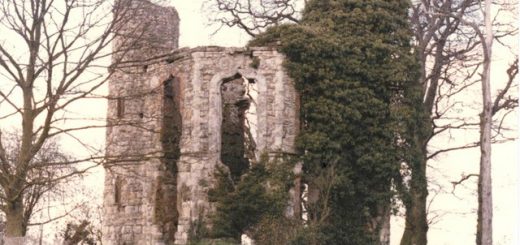
St Trinian’s church is the ruined shell of a 14th Century building standing at the foot of Mount Greeba on the Isle of Man. The chapel was the haunt of a Buggane: a fearsome creature of Manx folklore that appears in a number of folktales from the island.
There was a chapel at this location from at least the 12thC, the ruin being part of a later building from the 14thC. The church was an offshoot St Ninians Priory at Whithorn in Southern Scotland, which was a major centre of early Christianity.
 According to the tale the Buggane had his home in the mountain and was annoyed when the church was built – no doubt a threat to his supernatural hold over the area. Enraged by the sound of the bells the creature tore the roof from the building. On the day the third replacement roof was erected a young Taylor named Timothy agreed to a wager to finish a pair of breeches within the church, even though it was known that the Buggane would appear to tear the roof off once more.
The Taylor managed to keep his nerve as the Buggane rose slowly from the ground limb by grotesque limb, until the creature was almost ready to pounce and tear him to pieces. The Taylor just managed to put the last stitches in the fabric and jumped from the window as the Buggane tore the third roof from the walls. He managed to reach the safety of Marown Church with the Buggane hot on his heels. The creature was so furious that he missed his prize, that it tore off its own head and threw it over the church wall where it burst at the Taylor’s feet. Needless to say the Buggane was never seen again. The destruction and relocation of churches by the fairy races is a common enough folklore motif.
In this version the Buggane has a mane of course black hair, sharp tusks, eyes like flaming torches with a wide red mouth, with black wrinkled skin sharp claws and cloven feet.
According to Katherine Briggs the story is the same as the highland story of the haunted church at Bewley, the similarity being the gradual emergence of a creature from the ground limb by limb.

Re: The Buggane of St Trinians
There is a good narrative of the story here:
http://www.isle-of-man.com/manxnotebook/fulltext/sm1911/p153.htm
Re: The Buggane of St Trinians
Very nice story.
A few churches have an history about pre-Christian supernatural entities objecting about their construction.
Early Christianity has a widely mixed record about "paganism": quite a few old deities were simply taken over and turned into Saints (German theologist Harnack said "The Old Gods came back wearing brand new masks"), either by turning them directly into Christian Saints (St Eleutherios/Dyonisos, St Niceforos/Zeus etc) or by turning their dominion over to a Christian Saint (for example St Cosmas and St Damianus took over the healing aspects of Asklepios, the legendary healer). Other were turned into demons like many Celtic deities: the Irish missionaries which Christianized Britain were a tough lot, theologically speaking, and had little patience for "superstition".
In Distortion We Trust
Re: The Buggane of St Trinians
You could also consider siting legends as supernatural objections to building Christian places of worship. Usually where fairies are blamed for uplifting the stones being used and moving to their preferred location each evening.
Has there been a study on these type of legends. Do you think the type of legend we find could be limited to certain regions or even to the era in which the church was built?
Re: The Buggane of St Trinians
Well Ian, this tradition is surely not limited to a few areas of Britain: there are similar traditions from all over Europe and I recall even a missionary to West Africa relating how the local evil spirits (can we call them genii loci?) tried disrupting the construction of a small church in his parish.
As a time period, well, most of Europe may have been declared Christianized by the close of VI century but Paganism lived long "underground" for many more centuries. During the Counter-Reformations missionaries sent to the Venetian Alps to root out Protestants were shocked to discover that an old Roman temple dedicated to Hercules was still used by worshippers of the Old Faith near Capo di Ponte (Valcamonica). These "Cryptopagans" may have objected to the construction of new churches and sabotaged them or, much more simply, a practical joker may have decided to pull a fast one on the local clergy.
In Distortion We Trust
Re: The Buggane of St Trinians
The Isle of man is riddled with stories of ghosts, fairies and suchlike and is truly an enchanting place to visit, this story is still told along with many others by the loyal locals who fully believe in their tales.
Another story of the Mawtha Doo (pronounced mohda doo) which is the apparition of a spectral black dog foreboding certain soon death to the poor soul who witnesses seeing it. The hound is said to have been seen on the grounds of Peel Castle and even got a mention from Sir Walter scott in "the lay of the last minstrel"….
‘For he was speechless, ghastly, wan.
Like him of whom the story ran,
who spoke the spectre hound of Man.
There are many who still believe in the Fairies and still tip their hat and acknowledge them or bid them good day when crossing over the Fairy Bridge, according to Manx folklore it is very unlucky not to do so. There are flowers, letters and gifts hanging from the trees and below on the floor visitors have left for the fairies. Unfortunately the "real" fairy bridge is not this one which is located on the Castletown road between Castletown and Douglas but another one in Braddan which runs across middle river on a footpath near Kewaigue.
There are many supposed haunted locations on the island, having visited the island myself numerous times over the last 20 years i am totally convinced by most of them.
Re: The Buggane of St Trinians
THE BUGGANE OF ST. TRINIAN’S
Was the most notorious of these fiends in Man. The following story is told of him:–This religious edifice (St. Trinian’s) is said to have been erected in fulfilment of a vow made by a person when in a hurricane at sea, but, according to tradition, it was never finished. This was through the malice of a mischievous Buggane, or evil spirit, who, for want of better employment, amused himself with tossing the roof to the ground, as often as it was on the eve of being finished, accompanying his achievement with a loud fiendish laugh of satisfaction. The only attempt to counteract this singular propensity of the evil one, which tradition has conveyed to us, was made by Timothy, a tailor of great pretentions to sanctity of character. On the occasion alluded to, the roof of St. Trinian’s Church was, as usual, nearly finished, when the valorous tailor undertook to make a pair of breeches under it, before the Buggane could commence his old trick. He accordingly seated himself in the chancel, and began to work in great haste; but ere he had completed his job, the head of the frightful Buggane rose out of the ground before him, and addressed him thus–"Do you see my great head, large eyes, and long teeth?" "Hee! Hee!" that is, "Yes! yes!" replied the tailor, at the same time stitching with all his might, and without raising his eyes from his work. The Buggane, still rising slowly out of the ground, cried in a more angry voice than before, "Do you see my great body, large hands, and long nails?" "Hee!, Hee!" rejoined Tim, as before, but continuing to pull out with all his strength. The Buggane having now risen wholly from the ground, inquired in a terrified voice, "Do you see my great limbs, large feet, and long ——?" but ere he could utter the last word, the tailor put the finishing stitch into the breeches, and jumped out of the Church, just as the roof fell in with a crash. The fiendish laugh of the Buggane arose behind him, as he bounded off in a flight, to which terror lent its utmost speed. Looking behind, he saw the frightful spectacle close upon his heels, with extended jaws, as if to swallow him alive. To escape its fury Timothy leaped into consecrated ground, where, happily, the Buggane had not power to follow; but, as if determined to punish him for his temerity, the angry sprite lifted its great head from its body, and with great force pitched it to the feet of the tailor, where it exploded like a bomb shell. Wonderful to relate, the adventurous Timothy was unscathed; but the Church of St. Trinian remained without a roof.
[Folk-Lore of the Isle of Man (1891), by A.W. Moore]