The Mysterious Sites of Britain
Home
Site Map
Avebury
Stonehenge
Glastonbury
Hermitage CastleHermitage Castle
Rosslyn Chapel and CastleRosslyn Chapel
Callanais
Machrie MoorMachrie Moor
Wayland's Smithy
Aldworth Giants
Doon Hill
Uffington
Crossraguel Abbey
Castlerigg
Cerne Abbas
Tomnahurich
Clava Cairns
Kilmartin
Dunadd
Spynie Palace
St Bees Priory
Arbor Low
Silbury Hill
West Kennet Longbarrow
St Moluag's Church
St Michael's Mount
Long Meg
Spynie Palace
Photo: Lee Waterhouse
Spynie palace was the seat of the bishops of Moray for over 500 years; the atmospheric ruins now a shell of its former glory. The Palace - like many old historical buildings - has its share of traditions and ghost stories.
The founding of the palace dates back to 1200AD, when Bishop Richard relocated the cathedral of Moray to Spynie, then lapped by the waters Spynie Loch, which has since retreated to its present position. The sea loch provided a safe anchorage and aided the defence of the palace in those turbulent times. The cathedral was relocated to Elgin in 1224, but Spynie remained the fortified residence of the Bishops of Moray.

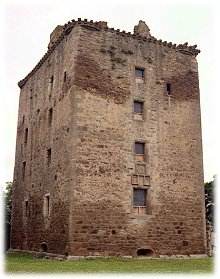
In 1390 the palace and the village was burned to the ground along with Elgin Cathedral by Alexander Stewart, The Wolf of Badenoch (see also Ruthven Barracks ). The palace was rebuilt by Bishop Innes, and part of the stone structure still survives from this time. The most impressive part of the Palace is the six-story tower, named David's Tower after Bishop David Stewart who oversaw its construction. The tower has impressively thick walls, and is one of the largest towers of this type in Scotland.

The palace had a number of important visitors over the years, James the IV stayed here in 1493 and 1505, Mary Queen of Scots in 1562 and James VI in 1589. The palace passed into the hands of Protestant Bishops, after the sweeping changes of the reformation led to the lands being sold to the Lindsay family.

The palace was besieged by General Munro in 1640, the General forcing Bishop Guthrie to surrender it to his forces. This really marked an end to Spynie as a seat of power, as the palace only survived until 1688 when the last Bishop was removed from office. From then on the palace fell into disrepair, with much of the stone work being robbed out.

Traditions: There are a number of traditions attached to the Palace; one is that of the ubiquitous phantom piper, a folklore motif common to many ancient castles. The other ghost is said to be that of a lion, although the root of this story is far from obvious. Some people contend that a lion was kept here as an exotic pet, which still wanders the ruins in spirit form. There has even been talk of lion's footprints being found within the ruins.

Photo: Lee Waterhouse

Photo: Lee Waterhouse

Photo: Lee Waterhouse

As with many seats - of what some locals may have thought of as oppressive - power, grim folklore grew up about the dark deeds of certain resident bishops. One was said to be a practitioner of Black Magic, who used his powers to summon evil spirits and Demons within the cyclopean walls of David's Tower. Traditionally the tower would be the focus of the witches Sabbath on the night of Halloween, when the tower would light up like fire, and the air would be filled with the sound of demonic merriment.

The site is certainly atmospheric and well worth visit for those searching for echoes of the past. The Palace is now in the care of Historic Scotland, who have done a great deal of restoration work at the site.
Map ref:NJ 231 658
Directions: Off the A941, North of Elgin.