Lough Derg
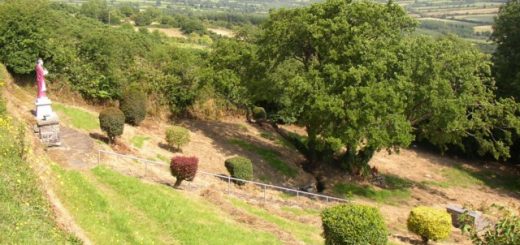
Lough Derg is a 2200 acre lake in County Donegal, famous for St Patrick’s Purgatory which is still a popular of pilgrimage as it has been many centuries. The original location of St Patrick’s Purgatory was on Saint’s Island, though now Station Island is used.
 There is a legend associated with Lough Derg and the great giant Fionn Mac Cumhaill (or Finn McCool, Finn Mac Coul), leader of the third century Irish warriors from Ben Bulben known as the Fianna. According to W Y Evans Wentz in ‘The Fairy Faith In Celtic Countries (1911)’ he cites Mr James Ryan of Tamlach Townland (age 75) as the source of this story which he was told during a visit in 1909.
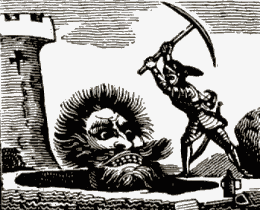
‘In his flight from County Armagh, Finn Mac Coul took his mother on his shoulder, holding her by the legs, but so rapidly did he travel that on reaching the shores of the lake nothing remained of his mother save the two legs, and these he threw down there. Some time later, the Fenians, while searching for Finn, passed the same spot on the lake-shore, and Cinen Moul (?), who was of their number, upon seeing the shin bones of Finn’s mother and a worm in one, said: “If that worm could get water enough it would come to something great.” ” I’ll give it water enough,” said another of the followers, and at that he flung it into the lake (later called Finn Mac Coul’s lake). Immediately the worm turned into an enormous water-monster. This water-monster it was that St. Patrick had to fight and kill; and, as the struggle went on, the lake ran red with the blood of the water-monster, and so the lake came to be called Loch Derg (Red Lake).’
Evans Wentz also noted that Campbell, John Gregorson Campbell and Alfred Trübner Nutt in ”The Fians; or, Stories, poems, & traditions of Fionn and his warrior band” (1891) gave a similar story about how Loch Lurgan received it’s name which I have recounted here.
‘She then took him on her back and fled with him to the Ulster wood. Getting tired, she let Fionn to the ground, and he, taking her by the shanks, placed her on the back of his neck and took her through the woods, heedless of her outcry and mindless of anything but escape from the pursuers. When he got out of the wood there was a lake in front of him, and he had nothing left of Speedy Foot but the shanks {an da lurgami); these he threw out on the loch, which derives its name from the occurrence — Loch Lurgan.’
Evan Wentz also recounted the legend concerning St Parick and the serpents of Ireland and the connections with Lough Derg.
‘I have always been hearing it said that into this lough St. Patrick drove all the serpents from Ireland, and that with them he had here his final battle, gaining complete victory. The old men and women in this neighbourhood used to believe that Lough Derg was the last stronghold of the Druids in Ireland; and from what I have heard them say, I think the old legend means that this is where St. Patrick ended his fight with the Druids, and that the serpents represent the Druids or paganism.’ These and similar legends, together with what we know about the purgatorial rites, lead us to believe that in pre-Christian times Finn Mac Coul’s Lake, later called Lough Derg, was venerated as sacred, and that the cave which then undoubtedly existed on Saints’ Island was used as ‘ a centre for the celebration of pagan mysteries similar in character to those supposed to have been celebrated in New Grange.’
Re: Lough Derg
I believe Lough Derg was also where the sidhe high king Bodb Derg lived…and it is also affliated with Brian Boru.
Re: Lough Derg
A reader e-mailed in with another story of Lough Derg following his visit there.
It occurred in the 6th cent. In that time, there was a community of holymen that lived on an island on the lake. Inis Cealtra, or the Holy Island.One of them was a simple man named Mac Creiche (MacCree). At the same time the mainland was being terrorized by a monster badger, the size of an Irish bull. It lived in nearby Lough na Brocknee, or the Lake of the Badger. it feasted on both people and farm animals. One by one,6 saints were called in to try and drive the beast away. Each one was consumed.
MacCreiche was told by God that he must leave the island. When he did, he fought the monster.What he did was put a chain around it’s neck and drown it in the lake. MacCreiche eventually traveled to the nearby town of Liscannor and started a church. His tomb is intact in the ruins.(I was there) On eitherside of the tomb are stylized badgers. There was also faded Latin writing,but I couldn’t make it out.
Re: Lough Derg
No salmon are said to be in Lough Derg as St Patrick put a curse upon it.