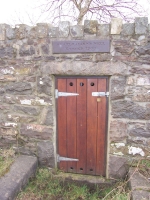
This well can be found on the outskirts of the village of Llanaelhaearn, on the left hand side of the road as you ascend the (B4417) out of the village. It is enclosed in a locked stone structure which was constructed in 1900, and it is in front of a house called Bryn Iddon.
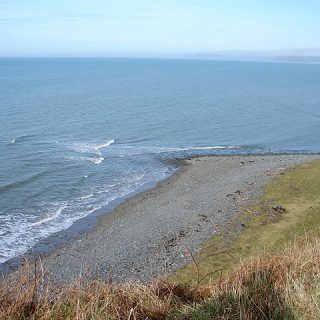
Ffynnon Fair can be found on the shore to the east of the precipitous rocks rising out of the sea known locally as ‘the wall’. This well always gives fresh water even though it is often covered over by the sea. It is said that a wish can be fulfilled by running with a mouthful of the water, three times around the quadrangle of the nearby St. Mary’s church.
Ffynnon Fair is a holy well situated outside the village of Llwyn-y-pia. The well is the oldest recorded Christian site in the Rhondda. Some historians date the site back further, and it could be pagan in origin. The water from the well is reputed to cure ailments, especially rheumatism and poor eyesight. Rhisiart ap Rhys wrote:
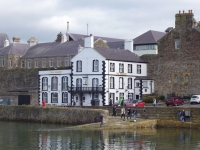
This traditional Welsh inn is a stone’s throw from the magnificent Caernarfon Castle, at the end of Castle Hill road. It overlooks the Menai Straits, and it is allegedly haunted. The building was formerly the Customs House in the 18th Century, and it situated on the site of Caernarfon’s ‘Hanging Tower’ which was the place of execution in the town.
Gwydir Castle is nestled in the Vale of Conwy in North Wales, and it has a long and fantastic history. The first recorded owner was Howell ap Coetmor, whose family members are recorded as having fought at the battles of Poitiers (1356), Shrewsbury (1402) and Agincourt (1415).
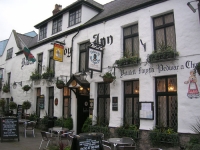
On Northgate Street, in the Royal Borough of Caernarfon, you will find an excellent free house called the Black Boy Inn which is reputedly haunted. When it was built, circa 1522 it consisted of two inns, one the ‘Kings Arms’ and the other the ‘Fleur de Lys’. At some stage, one landlord acquired both buildings and the ‘Black Boy’ as we know it today was created.
Sarn-y-Bwlch (Causeway of the Pass) is the middle of the three Cardigan Bay sarnau. It is the smallest of the three sarns, and it extends for about 6 kilometres offshore out from Pen Bwlch point at Tywyn, in a south westerly direction. Its charted depth is as shallow as 0.3 metres (Admiralty chart 1972).
Sarn Cynfelin (Saint Cynfelyn’s Causeway) is the southern most of the three Cardigan Bay sarnau, and begins just below the farmhouse at Wallog, situated on the cliffs between Borth and Clarach, and it extends for fourteen kilometres offshore into Cardigan Bay. Approximately half way along its length, it is bisected by a channel which is about five metres deep.
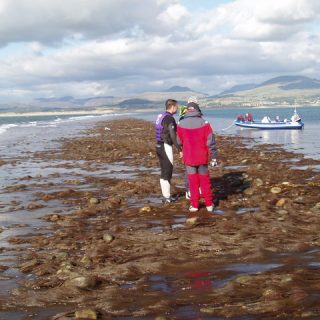
Sarn Badrig, also known as St. Patrick’s Causeway, starts from Mochras point on Shell Island (or Mochras) and extends out in to Cardigan Bay for about twenty-four kilometres (fourteen miles, some nine of which are exposed at neap tides). It is one of three such ridges of rock and shingle that can be found on this west Welsh coast.
In 1891 the following folk tale appeared in ‘The Science of Fairy Tales; An Enquiry Into Fairy Mythology’ by Edwin Sidney Hartland. It is one of a number of stories in which human midwives are needed at fairy births.
Our Mysterious Britain & Ireland site uses cookies to improve your experience. We assume you are ok with this, but you can opt-out if you wish. AcceptRead More
Privacy & Cookies Policy
Privacy Overview
This website uses cookies to improve your experience while you navigate through the website. Out of these cookies, the cookies that are categorized as necessary are stored on your browser as they are essential for the working of basic functionalities of the website. We also use third-party cookies that help us analyze and understand how you use this website. These cookies will be stored in your browser only with your consent. You also have the option to opt-out of these cookies. But opting out of some of these cookies may have an effect on your browsing experience.
Necessary cookies are absolutely essential for the website to function properly. This category only includes cookies that ensures basic functionalities and security features of the website. These cookies do not store any personal information.
Any cookies that may not be particularly necessary for the website to function and is used specifically to collect user personal data via analytics, ads, other embedded contents are termed as non-necessary cookies. It is mandatory to procure user consent prior to running these cookies on your website.

Recent Comments