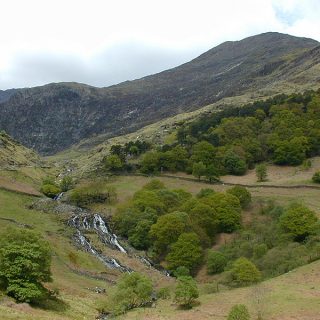
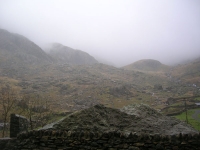
In this valley below the south eastern side of Yr Wyddfa (Mount Snowdon), it is said that the Tylwyth Teg (Fairy Folk) live. It is said that one day, a shepherd heard a wailing sound, and he moved a rock where the sound was coming from. When he did this he rescued a Tylwyth Teg who has trapped there. Later, he encountered two old men who thanked him, and gave him a staff.
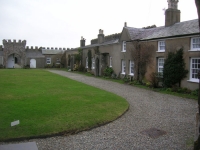
Fort Belan is a Grade I listed building dating from 1775 and was built by Member of Parliament, Sir Thomas Wynn, 1st Baron Newborough (born 1736 – died 12 October 1807), as a defence for the Menai Strait against possible naval aggression during the American War of Independence.
This well can be found on the roadside in the village of Bryncroes. It is on, what was the main pilgrim route to Bardsey Island through the Lleyn Peninsula. Bryncroes was the probably the final stop for pilgrims heading to embark from Aberdaron.
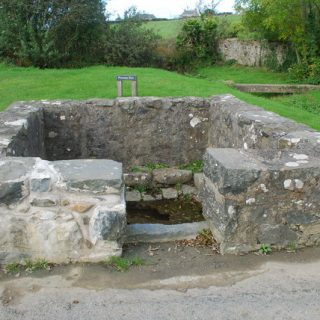
Fynnon Aelrhiw can be found in a field below the church. It is a rectangular basin in a larger surround with evidence of flat stone seats. People visited this well because its waters are meant to have a healing effect on skin diseases.
Ffynnon Fyw is a well within a stone wall enclosure of about 7.3m squared. There is evidence of steps for bathing access. It is said the well was dedicated to Curig and tradition credits it with the belief that it restores sight to the blind and health to the sick.
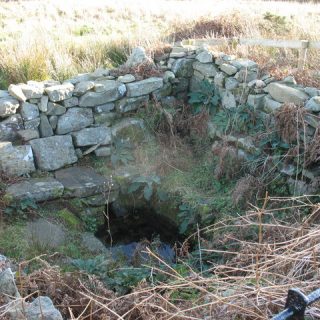
Ffynnon Arian in the village of Mynytho on the Llyn peninsula, Gwynedd is an ancient wishing well. It is a natural spring without traces of a structure according to ‘Holy Wells of Wales’.
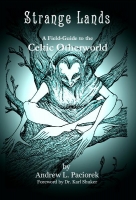
Andy Paciorek is one of Mysterious Britain & Irelands favourite contributors and his amazing artwork can be found illustrating articles throughout this site.
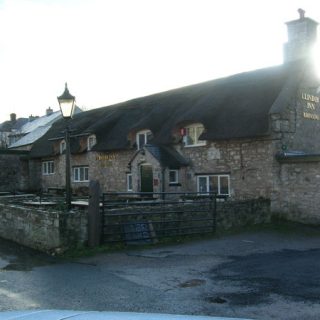
The thatched Grade II listed Llindir Inn dates from 1229 and is certainly one of the oldest pubs in Wales. It is reputed to be haunted by a ghost thought to be named Sylvia, the wife of a sailor who strangled her after finding her in the arms of another man whilst on unexpected shore leave.
According to John Rhys in his ‘Celtic Folklore Welsh And Manx’ [1901] ‘The following is a later tale, which Mr. Thomas Davies heard from his mother, who died in 1832:–‘When she was a girl, living at Yr Hafod, Llanberis, there was a girl of her age being brought up at Cwmglas in the same parish.
Our Mysterious Britain & Ireland site uses cookies to improve your experience. We assume you are ok with this, but you can opt-out if you wish. AcceptRead More
Privacy & Cookies Policy
Privacy Overview
This website uses cookies to improve your experience while you navigate through the website. Out of these cookies, the cookies that are categorized as necessary are stored on your browser as they are essential for the working of basic functionalities of the website. We also use third-party cookies that help us analyze and understand how you use this website. These cookies will be stored in your browser only with your consent. You also have the option to opt-out of these cookies. But opting out of some of these cookies may have an effect on your browsing experience.
Necessary cookies are absolutely essential for the website to function properly. This category only includes cookies that ensures basic functionalities and security features of the website. These cookies do not store any personal information.
Any cookies that may not be particularly necessary for the website to function and is used specifically to collect user personal data via analytics, ads, other embedded contents are termed as non-necessary cookies. It is mandatory to procure user consent prior to running these cookies on your website.
Recent Comments