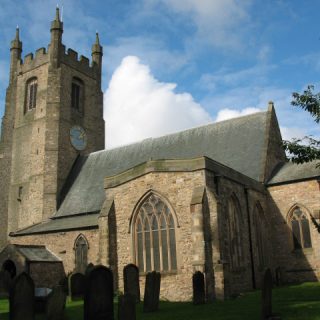
The Church of St Edmundthe Bishop at Sedgefield is a Grade I listed building dating from the 13thcentury. This church is associated with the story of the ‘Pickled Parson’. The following account of the story is extracted from ‘Legends Superstitions of the County of Durham’ by William Brockie (1886). ‘The Rev.
There is a group of four Round Barrows on Frensham Common. Three are clustered close to each other and the fourth is found roughly 150 meters to the north of them.
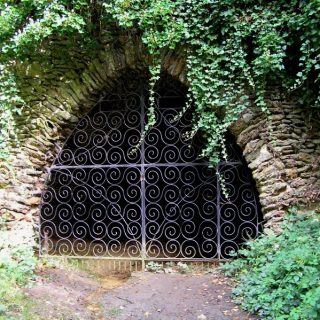
Mother Ludham’s Cave, was so named after the White Witch that was said to live in it. This small sandstone cave can be found in the Wey Valley and is also associated with the ruined Cistercian Waverley Abbey, or more correctly the spring inside it is associated with the monks that lived there. This spring was known as Ludwell and later St Mary’s Well.
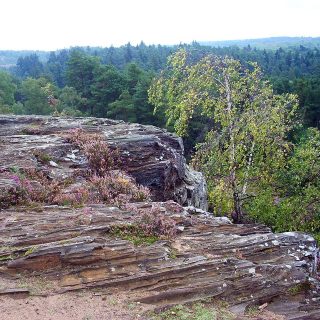
Osebury Rock (or Rosebury Rock) is a remarkable cliff with dense woodland on the River Teme which, according to Edwin Hartland in his ‘English Fairy and Other Folk Tales’ (1890), has an association with fairies.
The following story entitled ‘A Myth of Midridge’ was published in ‘English Fairy and Other Folk Tales’ (1890) by Edwin Sidney Hartland. ‘TALKING about fairies the other day to a nearly octogenarian female neighbour, I asked, Had she ever seen one in her youthful days?
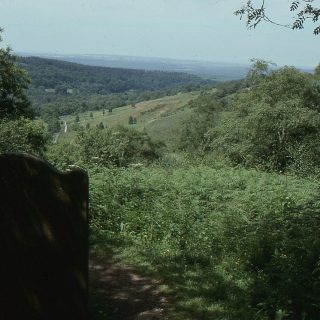
Three small hills near Churt have been known as the Devils Jumps (or the Devils Three Jumps) since at least 1765. The highest of the three hills is known as Stony Jump. There are a few folk tales attached to these hills which explains their name.
An article in the North Echo entitled ‘How railway builders took on the fairies’ was published on Monday 16 June 2008. It concerns the building of the Stockton and Darlington Railway in 1823 and refers to the local belief that fairies hindered progress at Myers Flat.
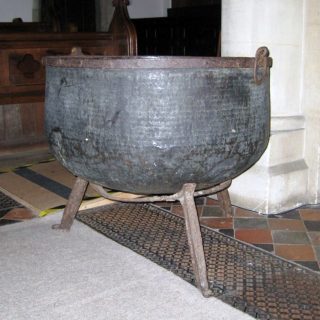
Inside the 13th century Church of Saint Mary the Virgin at Frensham is held a beaten copper cauldron. The medieval 19 inch deep cauldron is believed to have been used for the brewing of Church Ale and has apparently been kept in the church ‘from beyond the memory of man’.
Our Mysterious Britain & Ireland site uses cookies to improve your experience. We assume you are ok with this, but you can opt-out if you wish. AcceptRead More
Privacy & Cookies Policy
Privacy Overview
This website uses cookies to improve your experience while you navigate through the website. Out of these cookies, the cookies that are categorized as necessary are stored on your browser as they are essential for the working of basic functionalities of the website. We also use third-party cookies that help us analyze and understand how you use this website. These cookies will be stored in your browser only with your consent. You also have the option to opt-out of these cookies. But opting out of some of these cookies may have an effect on your browsing experience.
Necessary cookies are absolutely essential for the website to function properly. This category only includes cookies that ensures basic functionalities and security features of the website. These cookies do not store any personal information.
Any cookies that may not be particularly necessary for the website to function and is used specifically to collect user personal data via analytics, ads, other embedded contents are termed as non-necessary cookies. It is mandatory to procure user consent prior to running these cookies on your website.
Recent Comments