A hero celebrated for his hatred of witchcraft, was warming himself in his hunting hut, in the forest of Gaick, in Badenoch. His faithful hounds, fatigued with the morning chase, lay stretched on the turf by his side,–his gun, that would not miss, reclined in the neuk of the bothy,–the skian dhu of the sharp edge hung by his side, and these alone constituted his company.
Corrie Water is a stream running seven miles from Eskdalemuir to the Water of Milk near Lockerbie. The stream runs through Corrie, an ancient parish annexed to Hutton in 1609. It is here, according to a story by George Douglas in his Scottish Fairy and Folk Tales (1901) that fairies lived.
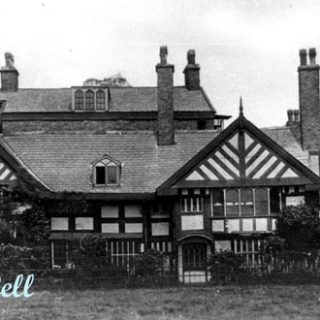
The Grade II listed Kersal Cell which dates from 1563 is the second oldest building in Salford and was the home of the English poet John Byrom (also known as John Byrom of Kersal and John Byrom of Manchester) (Born 29 February 1692 – Died 26 September 1763).
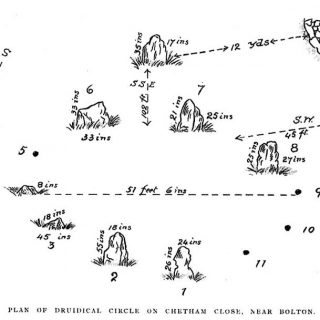
The remains of the early Bronze Age Cheetham Close stone circle lies between Chapeltown and Egerton. It measured 18.5 metres and according to a survey by Dryden in 1850, consisted of 6 stones. By 1871 the site was broken up by a tenant of Turton Tower angered by the visitors it was attracting.
There was an Egerton Hall which dated from 1826 and was built by Edmund Ashworth. This building was demolished in 1956. However, in ‘Lancashire Legends’ (1873), John Harland and T T Wilkinson refer to a haunted, older Egerton Hall, which was all but demolished by their time of writing and dating from possibly the 17th century.
An article by Joanna Moorhead in The Guardian on 26 October 2011 tells us that ‘Over at Coppergate Shopping Centre, site of a Viking fort, it seems an archaeological dig has disturbed spirits that had been lying dormant for centuries.
Ramhurst Manor House is a Grade II listed private residence on Powder Mill Lane dating from the 16th century or earlier. In the middle of the 19th century some strange experiences in the house resulted in it gaining a reputation for being haunted by members of the Children family who had resided there during the 18th century.
The John Snow public house at 39 Broadwick Street was named after Dr John Snow (Born 15 March 1813 – Died 16 June 1858), who traced the source of the Soho cholera outbreak of 31 August 1854 to contaminated water from a pump on Broadwick Street (known as Broad Street prior to 1936).
Broadwick Street was originally known as Broad Street and apart from being the site of a major outbreak of Cholera on 31 August 1854, about a hundred years earlier an apparitional experience was reported here. The following account of the experience was published in ‘The Haunted Homes and Family Traditions of Great Britain’ (1897) by John Ingram.
Our Mysterious Britain & Ireland site uses cookies to improve your experience. We assume you are ok with this, but you can opt-out if you wish. AcceptRead More
Privacy & Cookies Policy
Privacy Overview
This website uses cookies to improve your experience while you navigate through the website. Out of these cookies, the cookies that are categorized as necessary are stored on your browser as they are essential for the working of basic functionalities of the website. We also use third-party cookies that help us analyze and understand how you use this website. These cookies will be stored in your browser only with your consent. You also have the option to opt-out of these cookies. But opting out of some of these cookies may have an effect on your browsing experience.
Necessary cookies are absolutely essential for the website to function properly. This category only includes cookies that ensures basic functionalities and security features of the website. These cookies do not store any personal information.
Any cookies that may not be particularly necessary for the website to function and is used specifically to collect user personal data via analytics, ads, other embedded contents are termed as non-necessary cookies. It is mandatory to procure user consent prior to running these cookies on your website.
Recent Comments