Green Man of Fingest
Henry Burghersh (born 1292 – died 4 December 1340) was consecrated as the Bishop of Lincoln on 20 July 1320. According to the ‘Handbook to the Cathedrals of England’ (1881) ‘Anthony Bek, Chancellor of Lincoln, was elected by the Chapter on Bishop Dalderby’s death. His election was, however, annulled by the Pope, who appointed HENRY BURGHERSH……grandson* of Bartholomew de Badlesmere, the great Baron of Leeds Castle, by whose influence he obtained his bishopric, when only in his thirtieth year. He was the son of Sir Robert of Burghersh, and brother of Bartholomew, Lord Burghersh.’ On 14 April 1322 Bartholomew Badlesmere (born 1275) was executed after rebelling against King Edward II (this rebellion involved the siege of Leeds Castle in 1321 after Queen Isabella was refused entry by Margaret de Clare, Lady Badlesmere) and Henry’s lands were seized by the crown though eventually returned. Bishop Burghersh sided with Queen Isabella’s against the King who was eventually removed from office and resulted in his murder at Berkeley Castle in Gloucestershire. Burghersh served Henry III as Lord Treasurer (1327) before becoming Chancellor of England in 1328. However he lost his position temporally and was imprisoned when Queen Isabella was sentenced to be detained in Castle Rising for her part in the plot against Henry II.
The village of Tinghurst (from the saxon Thinghurst – ‘wooded hill where assemblies are made’) is know known as Fingest. In 1163, Tinghurst was given to the Bishop of Lincoln by the Abbey of St Albans and remained as a residence for the bishops of the diocese until 1547 and the dissolution of the monesteries. After becoming Bishop of Lincoln mid 1320, Henry first visited in Thinghurst 1321. According to the antiquarian Browne Willis (16 September 1682 – 5 February 1760) who wrote about Fingest and the manor house, Bishop Burgesh created a park for hunting, twenty years after first coming to Fingest and he was given licence to “impark 300 acres of land” which had been previously been common land. It is thought that 60 families lived in Thinghurst during this time and they relied upon the common land to feed themselves and Burghesh only left the community land totaling 100 acres (30 virgates). The hardship caused by Bishop Burghesh was deemed to be considerable and Fuller writing in the 17th Century says they saw “their own beef and mutton being turned into the bishop’s venison”.
The ‘Handbook to the Cathedrals of England’ (1881) has the following to say about the Bishop’s park. ‘Not long before his death, which occurred at Ghent, Bishop Burghersh had enclosed a park or deer chase, at Tinghurst, and in order to do so effectually had seized on certain lands held by some of his poorer neighbours. Their imprecations on the Bishop were loud and deep ; and Walsingham asserts that after his death he appeared to one of his friends, dressed in a short coat of Lincoln green, with a horn slung round his neck, and carrying a bow and arrows. As a punishment for his wrongs against the poor, he declared that he had been made keeper of the chase at Tinghurst ; and that he was condemned to wander about until the fences should be again thrown down and the lands restored to their former owners. The Canons of Lincoln accordingly, having been duly informed of the Bishop’s distress, proceeded to relieve him ‘in the way he had pointed out.’ In some accounts of the story the friend he appeared to with a message for the canons was his squire.
Quoting ‘The Cathedral Church of Lincoln – A History and Description of its Fabric and a list of the Bishops’, by Kendrick 1898 as a source, Gutch and Peacock in their 1908 ‘County Folk-Lore’ mentioned the tale of the ghost of Bishop Burghersh as if he appeared to the canons in person. ‘The legend runs that at Tinghurst, in Buckinghamshire, Bishop Henry Burghersh, ‘ by mere might against all right and reason,’ enclosed the land of many poor people, without recompense, in order to complete his park. The ghost of the bishop could not rest after his death, but appeared to the canons of Lincoln in hunting dress, telling them he was appointed keeper of the park, and beseeching them to throw it open. The canons, thus warned, restored the land to its rightful possessors.’
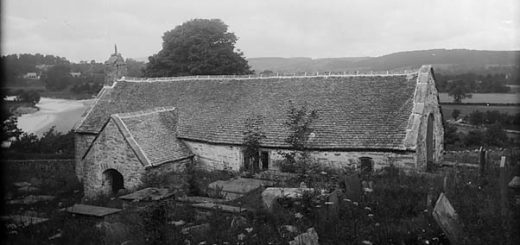
The Green Forester or Green Man of Fingest is said to have reputedly haunted the churchyard of the Norman (Grade I listed) St Batholomews and Chequers Lane as he walks between the site of the old manor house and the church. There seems to have been some conjecture as to whether the Bishop Burghesh’s ghost was successfully exorcised with the land being being made available to villagers once more and suggestions that this repentant bishop was somehow morphed if only in folklore into a ‘Green Man’ figure common in pagan traditions.
*Robert de Burghersh, 1st Baron Burghersh was married to Maud de Badlesmere, sister of Bartholomew de Badlesmere, 1st Baron Badlesmere. So Bartholomew de Badlesmere was Henry’s uncle, not grandfather.

Re: Green Man of Fingest
English Fairy and Other Folk Tales by Edwin Sidney Hartland [1890]
HENRY BURGWASH, who became Bishop of Lincoln on the 28th of May 1320, is chiefly memorable on account of a curious ghost story recorded of him in connection with the manor of Fingest, in Bucks. Until the year 1845, Buckinghamshire was in the diocese of Lincoln, and formerly the bishops of that see possessed considerable estates and two places of residence in the county. They had the palace of Wooburn, near Marlow, and a manorial residence at Fingest, a small secluded village near Wycomb. Their manor-house of Fingest, the ruins of which still exist, stood near the church, and was but a plain mansion, of no great size or pretensions. And why those princely prelates, who possessed three or four baronial palaces, and scores of manor-houses superior to this, chose so often to reside here, is unknown. Perhaps it was on account of its sheltered situation, or from its suitableness for meditation, or because the surrounding country was thickly wooded and well stocked with deer; for in the "merrie days of Old England," bishops thought no harm in heading a hunting party. Be this as it may, certain it is that many of the early prelates of Lincoln, although their palace of Wooburn was near at hand, often preferred to reside at their humble manor-house of Fingest. One of these was Henry Burgwash, who has left reminiscences of his residence here more amusing to posterity than creditable to himself. "He was," says Fuller, "neither good for church nor state, sovereign nor subjects; but was covetous, ambitious, rebellious, injurious. Yet he was twice lord treasurer, once chancellor, and once sent ambassador to Bavaria. He died A.D. 1340. Such as wish to be merry," continues Fuller, "may read the pleasant story of his apparition being condemned after death to be viridis viridarius–a green forester." In his Church History, Fuller gives this pleasant story: "This Burgwash was he who, by mere might, against all right and reason, took in the common land of many poor people (without making the least reparation), therewith to complete his park at Tinghurst (Fingest). These wronged persons, though seeing their own bread, beef; and mutton turned into the bishop’s venison, durst not contest with him who was Chancellor of England, though he had neither law nor equity in his proceeding." He persisted in this cruel act of injustice even to the day of his death; but having brought on himself the hatred and maledictions of the poor, he could not rest quietly in his grave; for his spirit was doomed to wander about that land which he had, while living, so unjustly appropriated to himself. It so happened, however, as we are gravely informed by his biographer, that on a certain night he appeared to one of his former familiar friends, apparelled like a forester, all in green, with a bow and quiver, and a bugle-horn hanging by his side. To this gentleman he made known his miserable case. He said, that on account of the injuries he had done the poor while living, he was now Compelled to be the park-keeper of that place which he had so wrongfully enclosed. He therefore entreated his friend to repair to the canons of Lincoln, and in his name to request them to have the bishop’s park reduced to its former extent, and to restore to the poor the land which he had taken from them. His friend duly carried his message to the canons, who, with equal readiness, complied with their dead bishop’s ghostly request, and deputed one of their prebendaries, William Bacheler, to see the restoration properly effected. The bishop’s park was reduced, and the common restored to its former dimensions; and the ghostly park-keeper was no more seen.