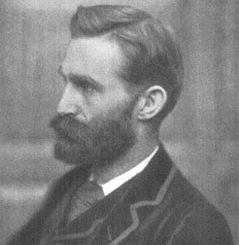
Aleister Crowley
Probably the most notorious magician of his period, if not of all time, Aleister Crowley has had far more influence after his death than at any time during his over-indulged life. His reputation as a drug fiend and evil man aside, his early writings show a keen intellect, and a good sense of humour in the more staid climate of his era. What follows is a brief summary of his life.
 Born Edward Alexander Crowley, on the 12th of October 1875 in Leamington Spa, Warwickshire. Crowley was brought up in the strict ruling of the Plymouth Brethren. His rebellion against his upbringing, and the fact that his mother identified him with the Great Beast of the Revelation, was something that would steer his life on the course of overindulgence and theatrical evil.
Crowley’s father died in 1887, and Crowley was sent to live with his mother’s brother, an alleged viscous bully called Tom Bishop, during that time he attended a school run by the Plymouth Brethren. Crowley’s childhood was a very unhappy one; he later described his experiences saying that it was only his iron will that got him through the whole experience.
Crowley soon came of age, and at 21 made a final split from his family. He became an undergraduate reading moral science at Cambridge University. Crowley seemed set for life; he had inherited his father’s fortune, and was mixing with people who were soon to become high movers in society.
 While at Cambridge he wrote poetry and started mountaineering, gaining a respectable reputation in both pursuits. He was a driven and courageous mountaineer, undertaking ambitious adventures in the Himalayas, his one problem being an inability to stand weakness in others. With regard to his poetry his pornographic and demonic prose was more notorious than critically acclaimed, but he managed to get much of his work published at home and abroad.
The real turning point in Crowley’s life came on November 18th 1889, when he was initiated into the Golden Dawn, the most influential occult group in Britain. He took the name Frater Perdurabo, which means I will endure.
He was not well liked by the majority of the members of the Golden Dawn. W. B. Yeats, the Irish poet called him “An unspeakable mad person” which paints a fairly colourful picture. During his time in the Golden Dawn he lived with a fellow member called Allan Bennet in a London flat. Here they experimented with magic rituals in two purpose built temples, and if Crowley is to be believed they had some startling results, including the manifestation of a host of supernatural beings and poltergiest activity. Crowley left the Golden Dawn after a supposed magical battle with MacGregor Mathers, who was ousted from the core in 1900 after accusing one of the founders of forging the documents on which the group was based.
In 1900 at the age of 25 Crowley moved into Boleskine House on the shores of Loch Ness in Scotland. His main aim was to find a quite place where he could continue his magical training. At Boleskine he is said to have summoned demons, held the black mass, and to have taken part in sexual orgies, charges later levelled at him while in Italy twenty years later.
 In his autobiography he describes how the spirits he summoned got out of hand, causing one housemaid to leave, and a workman to go mad. He also insinuates he was indirectly responsible for a local butcher accidentally severing an artery and bleeding to death. Crowley had written the names of some demons on a bill from the butcher’s shop. Whatever the truth Crowley revelled in controversy all his life and was not above fuelling dark rumours about his activities.
In 1902 his mountaineering exploits led him to attempt Chogo Ri in the Himalayas with Oscar Eckenstein. They spent 63 days surviving on the Baltero Glacier, and Crowley claimed to have climbed alone to a height of 22,000 feet, until he was driven back by severe weather conditions.
In 1903 he married Rose Kelly, his first wife, and one of the many women in Crowley’s life to end up broken and mad from the overindulgence of Crowley’s world.
In 1904 while on a trip to Cairo, his wife Rose, who was a medium, was inexplicably drawn to an exhibit with the number 666. Later an intelligence named Aiwas dictated the Book of Law through Rose, which contains the famous ‘Do what thou wilt shall be the whole law’. To Crowley the communion and trip were a sign and key into a new age, the age of Horus, and Crowley was to be its Messiah.
In 1905 Crowley’s mountaineering pursuits once again beckoned. He set off to conquer Kangchenjunga, which is the world’s third highest peak. There was great controversy during this abortive adventure; Crowley was accused of beating porters, and leaving men to die alone in an avalanche. There was also a slight mutiny within the camp. The trip added another black mark to his already growing reputation as an evil man.
In 1907 he formed the Argentinum Astrum or the Order of the Silver Star, A.A. for short. This was his own magical society allowing him complete control, he plundered much of the Golden Dawn’s system of rituals adding to them his own brand of sexual magic.
During 1909 he started the magazine Equinox, in which he published some of the Golden Dawn’s second order secrets. He also divorced his wife Rose in the same year. She was a hopeless alcoholic by this time, probably through Crowley laying the blame on her for his daughter’s death. She ended up in a lunatic asylum shortly afterwards.
 In 1912 he visited Germany and met with Theodor Reuss, who was the head of the ten year old Ordo Templi Orientis. He was appointed the head of the British O.T.O, which was heavily influenced by erotic magic. He took the magnificent title of ‘Supreme and Holy King of Ireland, Iona and all other Britons within the Sanctuary of the Gnosis’.
In 1915 he moved to New York in the U.S.A, and spent the following years of the First World War writing anti British propaganda for the Germans. This was another black mark for the man the British press were soon to dub ‘The Wickedest Man in the World’.
In 1916 he rose to the rank of Magus by crucifying a toad after he had baptised it Jesus Christ. The German branch of the OTO also severed links with the British chapter at this time, many of the German members were wary of Crowley, and there was also the fact that Germany was at war with Britain.
In 1920 he went to Cefalu with his current scarlet woman Leah Hirsig, and formed the Abbey of Thelema in a converted Villa. It was the resulting press coverage from his time here that gained him worldwide notoriety. He was accused of conducting sexual orgies, the black mass and animal sacrifices as well as all forms of diabolical magic. The real disaster came when one of the members of the Abbey, an Oxford Graduate called Raoul Loveday, died of enteritis at the Abbey. His wife accused Crowley of poisoning him by making him drink the blood of a cat during one of their ceremonies, and her campaign against him in London fuelled the increasingly bad press.
While reports were undoubtedly exaggerated, there is no smoke without fire, and by 1923 the Italian government had had enough of his apparent diabolical activities and expelled him. As always Crowley revelled in the accusations, and did not deny any of the allegations.
The expulsion from Italy was the beginning of an overall downturn for Crowley, he still travelled widely but his band of followers dwindled, and he never really gained the same influence over a large audience until after his death. He did however take control of the OTO, Theodor Reus retired in 1923 and named Crowley as his successor. There was some disagreement about the decision amongst members, but he was finally confirmed as leader in 1924. He continued as head until a 1946, when he relinquished control to Kenneth Grant.
In 1929 much of what now forms ‘Magick in Theory and Practice’ was published, 1929 also saw the publishing of one of his best occult novels ‘Moonchild’.
 In 1934 Crowley was declared bankrupt after losing a court case in which he tried to sue the artist Nina Hamnett for calling him a Black Magician. The evidence against him must have been overwhelming, and it is difficult to see why he ever took the case to court.
As old age beckoned he retired to Hastings, where he was still in communication with some of the leading lights on the occult scene at that time, including Gerald Gardner, Montague Summers and Isreal Regardie. He was not above commenting on the practices of others, and wrote vehemently about R.L Hubbard and Jack Parsons trying to raise a moonchild in the U.S.A. He also continued working on his interpretation of the Tarot ‘The Book of Thoth’, which was published in 1944.
Crowley died in Hastings on the 1st of December 1947 aged 72 years, he was still a heavy heroin user at this time, taking a dosage that would have killed at least five people.
The resurgence of interest in Crowley took off in the 1960s, a time of occult revival and freethinking in the western world. His work is still of value today and his books, although heavy going in some places, are intelligently written and form the beginnings of a psychological approach to magical practice.
Re: Aleister Crowley
Two quick things about the Abbey of Thelema.
According to most recent research Loveday died of gastroenteritis brought on by drinking water from a local pool, something the locals had advised him against. Crowley later played on how he had given the advice himself, of course.
Second: according to my Sicilian contacts the villa is still standing, though it’s in very bad state.
The famous murals were whitewashed by order of the local authorities after Crowley left in 1923.
Part of them were uncovered by one of Crowley’s followers, Kenneth Anger, in the ’50s. The rest were uncovered by local and foreign occultists over the following fifty years. Sicily is a veritable hotbed of occult interest, ranging from serious and devoted researchers to "weekend Satanist" types.
While the villa itself is in very bad shape, the murals themselves are remarkably well preserved and many pictures have recently surfaced on the Internet.
The Abbey’s status is currently unclear: nobody knows who owns title to it.
The windows and doors have been boarded or bricked over to prevent access many times again but daring types have always managed to find ways to get in.
Since the status of the building is presently unknown and the building is so degraded I strongly warn against trying to gain entrance.