Country and County: Scotland

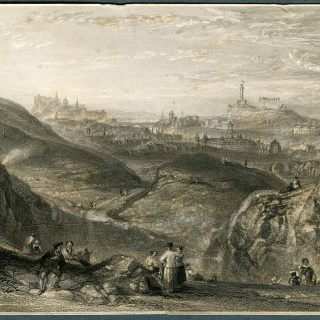
St Anthony’s Well, Edinburgh

Prior to 1674 St Anthony’s Well flowed from beneath a small stone arch in a slightly higher position to the bolder from under which it now sprouts. It was probably connected to the nearby 15th century St Anthony’s Chapel which is now a ruin.
The Well Of The Holy Rood, Stenton

The 16th century Well of the Holy Rood at Stenton has a legend attached to its finial which resembles a rosetted cardinal’s hat. The legend states that the tenure of Beil depends upon the well keeping its hat.

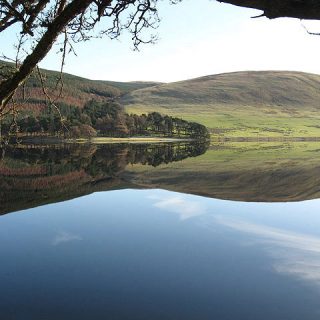
St Mary’s Loch

James Hogg (born 1770 – died 21 November 1835) ‘The Ettrick Shepherd’ wrote the following concerning a water cow that was said to have lived in the 5 km long St Mary’s Loch, which is the largest natural loch in the Borders.

Nine Maidens Well, Strathmartine

As with the dragon that was associated with it, very little remains of the Nine Maidens Well at Strathmartine, as the farmer upon whose land it could be found had the well covered up to stop it’s visitors from trampling his crops.

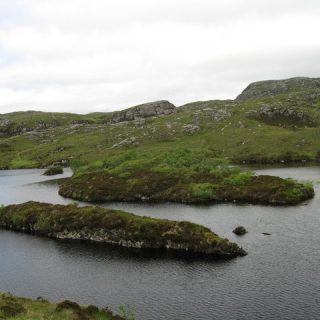
Loch na Beiste

In his ‘Guide to Gairloch and Loch Maree’ (1886), John H. Dixon gave the following account of a creature that was said to live in Loch na Beiste roughly 50 years early. ‘The existence of water-kelpies in Gairloch, if perhaps not universally credited in the present generation, was accepted as undoubted in the last.

The Water Horse Bridle of Nether Lochaber

In Folklore of Scottish Lochs and Springs (1893), James Mackinlay quotes an anecdote by Rev Dr Stewart, ‘A drover, whose home was in Nether Lochaber, was returning from a market at Pitlochry by way of the Moor of Rannoch. Night came on; but, as the moon was bright, he continued his journey without difficulty. On reaching Lochanna Cuile, he sat down to refresh himself with bread, cheese, and milk.

Loch Ness Water Horse

James Mackinlay in his Folklore of Scottish Lochs and Springs (1893) tells of another creature that was said to lurch in Loch Ness. ‘A noted demon-steed once inhabited Loch Ness, and was a cause of terror to the inhabitants of the neighbourhood.

Woodhouselee

On 23d January 1570, the Regent of Scotland, James Stewart, 1st Earl of Moray (born 1531) was assassinated in Linlithgow by a sniper firing a 3’5” long, hexagonal bore barreled carbine from a house window. The assassin was James Hamilton of Bothwellhaugh the nephew of Archbishop John Hamilton, from who’s window he fired the fatal shot.