In her 1848 publication ‘The night side of nature, or, Ghosts and ghost seers’, Catherine Crowe describes an apparition witnessed at the apartment of a Cambridge University student. Unfortunately in the account repeated below there is no indication as to the exact location where this experience took place or when it happened.
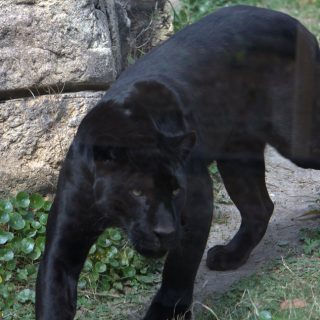
On 14 February 2011 an article entitled ‘Panther on the Prowl’ appeared on the Wigan Today website concerning the sighting of a large black cat in Bryn and animal remains being found in a local recreation area.
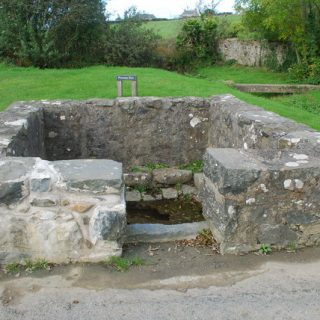
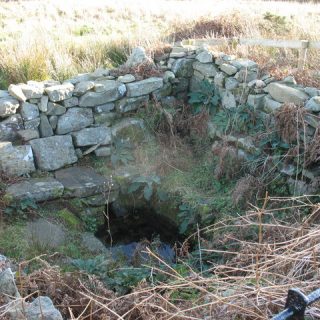
This well can be found on the roadside in the village of Bryncroes. It is on, what was the main pilgrim route to Bardsey Island through the Lleyn Peninsula. Bryncroes was the probably the final stop for pilgrims heading to embark from Aberdaron.
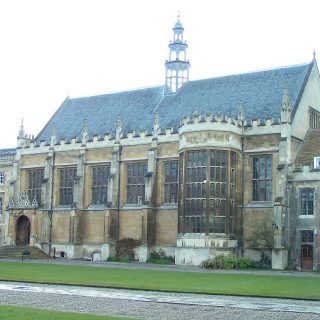
In a History of the Supernatural (1863), William Howitt mentions a haunting associated with Trinity College, Cambridge. He had obtained the information from the poet William Wordsworth (7 April 1770 – 23 April 1850), who in turn had been informed of it by his youngest brother, Christopher Wordsworth (9 June 1774 – 2 February 1846), The Master of Trinity.
A strange experience concerning a potential haunting was recounted in the The Diary of Abraham de la Pryme, the Yorkshire Antiquary, published 1870. This haunting seemed to have made an impression on 17th century Cambridge though given the way in which the activity ceased it is very possible that the events were hoaxed.
Fynnon Aelrhiw can be found in a field below the church. It is a rectangular basin in a larger surround with evidence of flat stone seats. People visited this well because its waters are meant to have a healing effect on skin diseases.
Ffynnon Fyw is a well within a stone wall enclosure of about 7.3m squared. There is evidence of steps for bathing access. It is said the well was dedicated to Curig and tradition credits it with the belief that it restores sight to the blind and health to the sick.
Ffynnon Arian in the village of Mynytho on the Llyn peninsula, Gwynedd is an ancient wishing well. It is a natural spring without traces of a structure according to ‘Holy Wells of Wales’.
During the 17th Century an incident linked to poltergeist like activity in Glenluce became was recorded and published by Glasgow’s first Professor of Mathematics and demonologist, George Sinclair (died 1696) in his 1685 work, ‘Satan’s Invisible World Discovered’.
Our Mysterious Britain & Ireland site uses cookies to improve your experience. We assume you are ok with this, but you can opt-out if you wish. AcceptRead More
Privacy & Cookies Policy
Privacy Overview
This website uses cookies to improve your experience while you navigate through the website. Out of these cookies, the cookies that are categorized as necessary are stored on your browser as they are essential for the working of basic functionalities of the website. We also use third-party cookies that help us analyze and understand how you use this website. These cookies will be stored in your browser only with your consent. You also have the option to opt-out of these cookies. But opting out of some of these cookies may have an effect on your browsing experience.
Necessary cookies are absolutely essential for the website to function properly. This category only includes cookies that ensures basic functionalities and security features of the website. These cookies do not store any personal information.
Any cookies that may not be particularly necessary for the website to function and is used specifically to collect user personal data via analytics, ads, other embedded contents are termed as non-necessary cookies. It is mandatory to procure user consent prior to running these cookies on your website.

Recent Comments