Tunstead farm has a skull named Dickie that had its height of fame during the 19th century. The name seems strange in that legend suggests the skull is actually that of a woman, who was murdered within the house. Before she died she managed to blurt out that it was her wish for her remains to stay within the house forever.
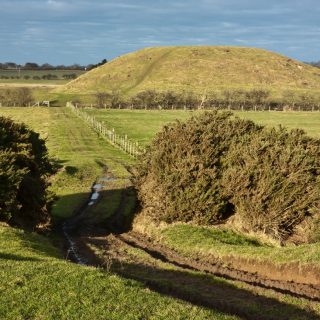
Skipsea Castle dates from around 1086 and was one of the early Norman period Motte and Bailey Castles. The remains of the castle which was destroyed in 1221 when William de Froz II rebelled against King Henry III (born 1 October 1207 – died 16 November 1272) are traditionally thought to be haunted by a white lady, the wife of Drogo de la Bouerer, who founded the castle.
Chibber Undin (Chibbyr Undin) – The Foundation Well or Chibber Undin when written about in the late 19th century was described as being close to the remains of an ancient Keeill which a Manx word for cell or chapel and these remains are often quoted as measuring 21 feet long by 12 feet broad.
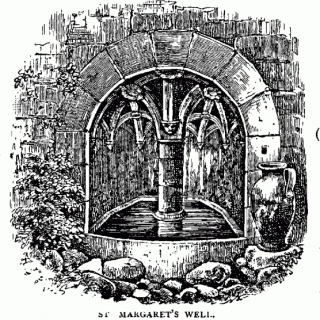
During the 1860 St Margaret’s Well was moved to its present location from the crossroads between Holyrood and Restalrig. It was described in 1852 as ‘a spring well, enclosed by an ancient vault over which part of the railway workshops had been built.’
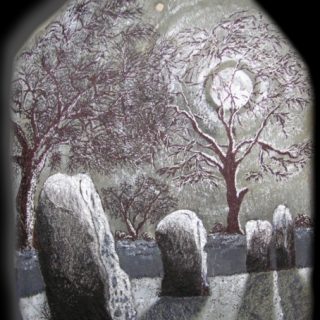
Kerry McKenna is an artist, singer and musician based in Avebury, Wiltshire. Earlier this year I came across her slate paintings whilst visiting Avebury and was immediately impressed. What I didn’t know was about her UFO experience or her conferences. Enough from me, I’ll let Kerry introduce herself – (intro by Ian Topham)
Argyll House (246 – 250 Regent Street) occupies the site where the Argyll Rooms once stood back before Regent Street was laid out. In 1830 during a concert recital at the Argyll Rooms a young woman saw an apparition which was recounted in the diary of the dandy merchant banker, Thomas Raikes (born 3 October 1777 – died 3 July 1848).
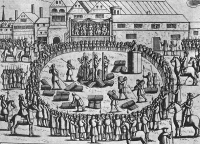
Smithfield haled a fairly prominent place in medieval London. Not only was it the site of a famous market and a place where Royalty held their tournaments, the Elms at Smithfield was also well known as a place of execution and it is thought that some of those who were cruelly killed at this spot may haunt it still.
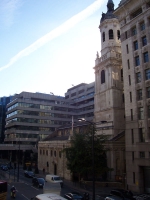
St Magnus the Martyr was the second church to be damaged during the Great Fire of London in 1666 and was subsequently rebuilt by Sir Christopher Wren (born 20 October 1632 – died 25 February 1723) at a cost of £9,580.
Our Mysterious Britain & Ireland site uses cookies to improve your experience. We assume you are ok with this, but you can opt-out if you wish. AcceptRead More
Privacy & Cookies Policy
Privacy Overview
This website uses cookies to improve your experience while you navigate through the website. Out of these cookies, the cookies that are categorized as necessary are stored on your browser as they are essential for the working of basic functionalities of the website. We also use third-party cookies that help us analyze and understand how you use this website. These cookies will be stored in your browser only with your consent. You also have the option to opt-out of these cookies. But opting out of some of these cookies may have an effect on your browsing experience.
Necessary cookies are absolutely essential for the website to function properly. This category only includes cookies that ensures basic functionalities and security features of the website. These cookies do not store any personal information.
Any cookies that may not be particularly necessary for the website to function and is used specifically to collect user personal data via analytics, ads, other embedded contents are termed as non-necessary cookies. It is mandatory to procure user consent prior to running these cookies on your website.

Recent Comments