The original tale first appeared in The Athenaeum, published in 1847, and tells how a tyrannous figure became even more fearsome as a ghost after he had died. Three brave priests finally exorcise the ghost with a mix of magic and prayer.
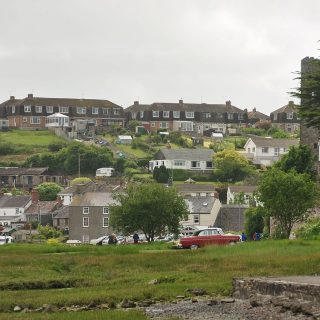
A spectral dog known as the Gwyllgi or the ‘Dog of Darkness’ is said to haunt the town. The dog appears with flaming red eyes, and is said to run from the castle to the town along an old route-way.
Ogaf Myrddin means Merlin’s Cave, and this is one of the locations where he is said to sleep awaiting his release. The cave is hidden behind a waterfall.
This is the version translated by Lady Charlotte Guest, and published in 1849 in the collection of old Welsh tales entitled the Mabinogion. Traditionally Taliesin is placed in the time of Arthur, which is generally believed to be in the 6th century AD.
The whole area around Dyfed is associated with Arthur, outlined in the old Welsh tales now part of the Mabinogion. This cairn on the hilltop is thought to be Arthur’s Grave.
Directions: The grave is in the Prescely Mountains
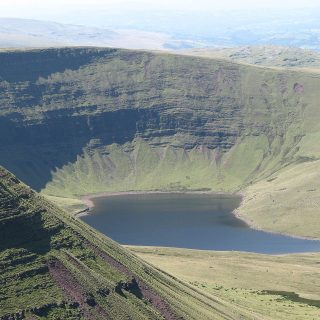
This tale tells how a young shepherd won and lost a fairy bride from Lynn y Fan Fach (Van Vach), the fairy lake at the foot of Bannau Sir Gaer in the Brecon Beacons. This version was collected and told by Joseph Jacobs and appeared in his book Celtic Fairy Tales published in 1892 (David Nutt).
The Welsh version of the Cornish Knockers, these mine spirits were relatively good humoured, and helped the miners by knocking in places with rich lodes of mineral, or metal. The Coblynau dressed in miners’ attire, and stood at around 18 inches in height.
The Cwn Annwn, which means hounds of the otherworld (underworld), are Welsh phantom dogs seen as a death portent. Their growling is louder when they are at a distance, and as they draw near the growling grows softer and softer.
Bendith Y Mamaumeans ‘the mothers blessing’ and is a generic name for the fairies, especially in Southern Wales.
In appearance the fairies are described as small and ugly, and are most readily identified with the Brownies, or the West Country Pixies, although they have the characterisations of most fairies.
Our Mysterious Britain & Ireland site uses cookies to improve your experience. We assume you are ok with this, but you can opt-out if you wish. AcceptRead More
Privacy & Cookies Policy
Privacy Overview
This website uses cookies to improve your experience while you navigate through the website. Out of these cookies, the cookies that are categorized as necessary are stored on your browser as they are essential for the working of basic functionalities of the website. We also use third-party cookies that help us analyze and understand how you use this website. These cookies will be stored in your browser only with your consent. You also have the option to opt-out of these cookies. But opting out of some of these cookies may have an effect on your browsing experience.
Necessary cookies are absolutely essential for the website to function properly. This category only includes cookies that ensures basic functionalities and security features of the website. These cookies do not store any personal information.
Any cookies that may not be particularly necessary for the website to function and is used specifically to collect user personal data via analytics, ads, other embedded contents are termed as non-necessary cookies. It is mandatory to procure user consent prior to running these cookies on your website.
Recent Comments