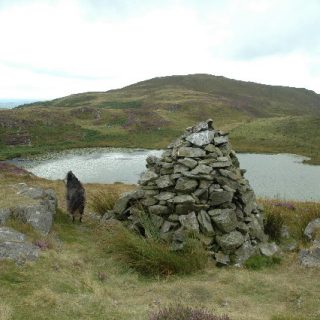
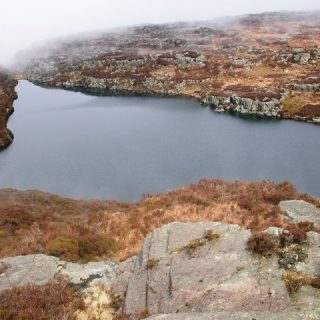
Llyn Barfog is situated in high countryside above the northern banks of the River Dyfi. The lake is isolated, small, and covered with yellow water lilies in the summer. Sir John Rhys in Celtic Folklore suggests that it was originally called Llyn-y-Barfog (The Bearded One’s Lake) referring to some ancient mythical being who would have lived there.
This is a privately owned lake beside the B4418 which has a rather complex shape and a small island in the centre, which is not uncommon in highly glaciated areas. There is a curious story attached to this lake. Once upon a time Llyn-y-Dywarchen had an additional floating island.
Four miles North from Capel Curig along the A5; and at 310 metres above sea level you’ll find Llyn Ogwen covering an area of 78 acres. Its ancient name was reportedly Ogfanw (young pig); and it is one of the shallowest lakes in North Wales, averaging 6 feet, and only being 10 feet at its deepest point.
Llyn Morwynion is probably the lake where, according to the Mabinogion, Blodeuedd and her Maidens of Ardudwy drowned whilst fleeing from the wizard Gwydion and the men of Gwynedd.
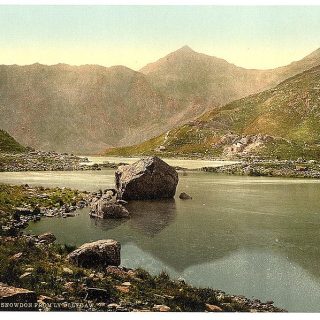
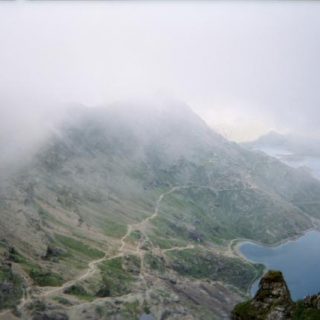
At 1,430 feet above sea level Llyn Llydaw (Brittany Lake) is another sterile glacial lake of Yr Wyddfa (Mount Snowdon) in its eastern valley Cwn Dyli. It has an industrial air about it, and it has the Miners’ track crossing its eastern end by a causeway that was built in 1853 when the lake was lowered.
At 1,970 feet above sea level, and covering an area of 18 acres Llyn Glaslyn is one of the glacial lakes of Yr Wyddfa (Mount Snowdon), and being the highest and remotest of the larger lakes it abounds in legend.
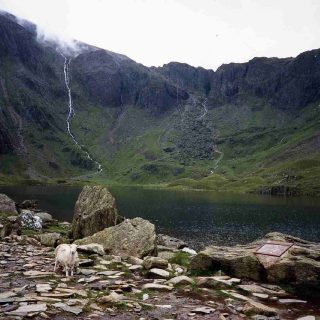
Llyn Idwal is a small glacial lake in Snowdonia, easily accessible from the A5. The path begins at Ogwen Cottage at the foot of Llyn Ogwen, crosses a stream and then turns right after a quarter of a mile in to Cwm Idwal, a dramatic valley surrounded by the crags of Glyder fawr, Twll Du (‘The Black Hole’ or more popularly known as ‘the Devils Kitchen’) and Y Garn.
The following account of a poltergeist in Barmouth appeared in an edition of Folk-lore (June 1892) and was also reproduced in Richard Holland’s ‘Haunted Wales: A Guide to Welsh Ghostlore’
In his excellent book ‘Haunted Wales: A Guide to Welsh Ghostlore‘, Richard Holland quotes the following article concerning a poltergeist at Pant-y-Wennol near Abersoch that appeared in the Caernarvon & Denbigh Herald, 29 May 1866.
Lying in the Vale of Ffestiniog, alongside the river Dwyryd, is the village of Maentwrog. There is a legend that a giant called Twrog (who died in the year AD610) hurled a stone from a hill top, down into the village and destroyed a pagan altar.
Our Mysterious Britain & Ireland site uses cookies to improve your experience. We assume you are ok with this, but you can opt-out if you wish. AcceptRead More
Privacy & Cookies Policy
Privacy Overview
This website uses cookies to improve your experience while you navigate through the website. Out of these cookies, the cookies that are categorized as necessary are stored on your browser as they are essential for the working of basic functionalities of the website. We also use third-party cookies that help us analyze and understand how you use this website. These cookies will be stored in your browser only with your consent. You also have the option to opt-out of these cookies. But opting out of some of these cookies may have an effect on your browsing experience.
Necessary cookies are absolutely essential for the website to function properly. This category only includes cookies that ensures basic functionalities and security features of the website. These cookies do not store any personal information.
Any cookies that may not be particularly necessary for the website to function and is used specifically to collect user personal data via analytics, ads, other embedded contents are termed as non-necessary cookies. It is mandatory to procure user consent prior to running these cookies on your website.
Recent Comments