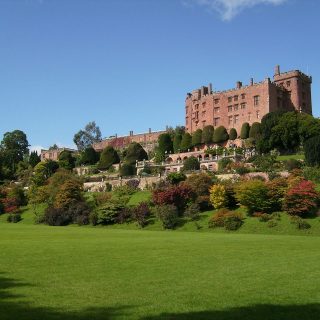
Powis Castle dates back to the 13th century when it was a medieval stronghold for the Welsh princes of Powys. It is now the ancestral home for the Earls of Powis and has been continuously lived in for over seven hundred years. It is only to be expected that a castle with such a long history would have acquired a few ghosts over the years.
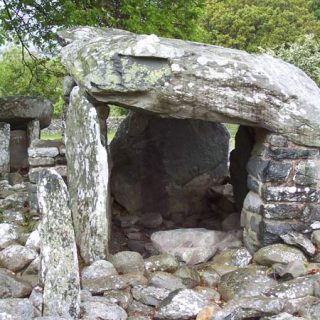
Behind the local school at Dyffryn Ardudwy and reached by a sign posted footpath two exposed cromlechs are visible amidst a field of stones. The cromlechs are about twenty feet apart and the stones that surround them mark the remains of the huge cairn that would have covered these graves that date back to the Neolithic period.
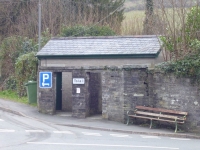
I came across a reference claiming that the public toilets opposite the Gwesty’r Llew Coch (Red Lion Hotel) in Dinas Mawddwy are reputedly haunted by the apparition of a silver haired old man. I have no idea what evidence this based upon, or even if there is any.
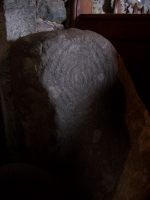
St Peters Church in Llanbedr is where you can find, behind the rear pew, an ancient engraved stone that stands two foot nine inches in height and two foot wide. The engraving is that of a seven turn spiral measuring twelve inches in diameter. It is said to be similar to those associated with the Irish Boyne culture.
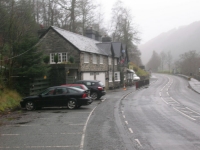
The Tyn-y-Groes Hotel is an old drovers inn dating the sixteenth century. I found a reference in a Snowdonia walking book stating strange haunting like phenomena was supposed to have been reported shortly after a young girl was run down in a traffic accident on the A470, just outside the building.
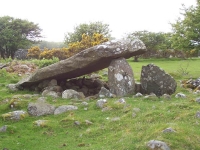
The Cors-y-Gedol burial chamber which still has it’s capstone intact is also referred to as Arthur’s Quoit and can be found close to some ancient hut circles known as the Irishmen’s huts on the slope of Moelfre.
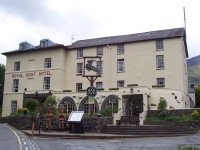
The Royal Goat Hotel is linked to stories suggesting a haunting, though I don’t know of any actual haunting type occurrences that have happened there. The stories relate to David Pritchard, the first landlord of the Royal Goat Hotel and the man generally thought responsible for the Grave of Gelert.
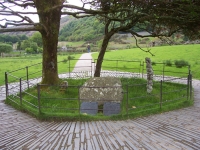
‘In the 13th century Llywelyn, prince of North Wales, had a palace at Beddgelert. One day he went hunting without Gelert, "The Faithful Hound", who was unaccountably absent. On Llywelyn’s return the truant, stained and smeared with blood, joyfully sprang to meet his master.
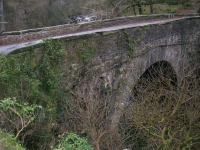
Pont Aberglaslyn has a bridge with a connection to the Devil. It is very similar to other Devil and bridge related stories found throughout the British Isles. The Devil built the bridge on the understanding that he would receive the soul of the first living creature to cross over it. When the bridge was finished he went to the local inn to inform the magician Robin Ddu that it was ready.
Our Mysterious Britain & Ireland site uses cookies to improve your experience. We assume you are ok with this, but you can opt-out if you wish. AcceptRead More
Privacy & Cookies Policy
Privacy Overview
This website uses cookies to improve your experience while you navigate through the website. Out of these cookies, the cookies that are categorized as necessary are stored on your browser as they are essential for the working of basic functionalities of the website. We also use third-party cookies that help us analyze and understand how you use this website. These cookies will be stored in your browser only with your consent. You also have the option to opt-out of these cookies. But opting out of some of these cookies may have an effect on your browsing experience.
Necessary cookies are absolutely essential for the website to function properly. This category only includes cookies that ensures basic functionalities and security features of the website. These cookies do not store any personal information.
Any cookies that may not be particularly necessary for the website to function and is used specifically to collect user personal data via analytics, ads, other embedded contents are termed as non-necessary cookies. It is mandatory to procure user consent prior to running these cookies on your website.
Recent Comments