Country and County: United Kingdom
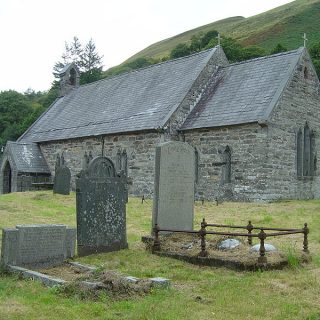
In the village of Llanymawddwy, there is an ancient church dedicated to St. Tydecho, thought to be the son of Anna Pendragon, King Arthur’s sister. Wirt Sykes in British Goblins (1881) gives the following tale of St. Tydecho and a blue stone. ‘There was a stone in the valley of Mowddwy, which did good service for the church. A certain St.
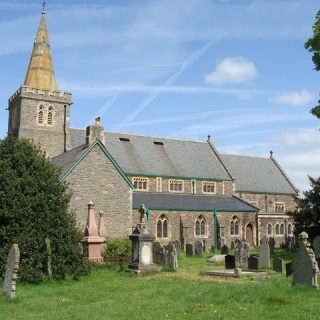
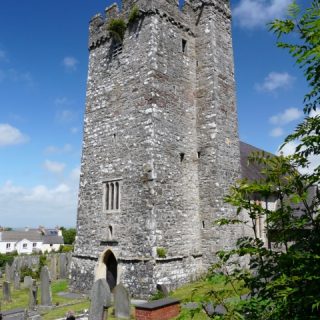
The Grade II listed Church of St David in Llanfaes dates from 1923-25. This church replaced an earlier one built in 1859. It has been suggested that this Victorian St David’s that was constructed by J Clayton, was built beside the remains of an earlier medieval church. The church at Llanfaes has been recorded as early as 1291 in the ‘Ecclesia de Lanmays’.
Drakelow in Worcestershire derives its name from a mythological creature – the dragon. The word for dragon in Germanic mythology and its descendants is worm (Old English: wyrm, Old High German: wurm, Old Norse: ormr), meaning snake or serpent. In Old English wyrm means "serpent", draca means "dragon" (Skeat).
Llech Lafar, a speaking slab of marble by the River Alun is referred to by Wirt Sykes in his ‘British Goblins’ (1881). ‘The Talking Stone Llechlafar, or stone of loquacity, served as a bridge over the river Alyn, bounding the churchyard of St. David s in Pembrokeshire, on the northern side.
Written by fellow ASSAP (Association for the Scientific Study of Anomalous Phenomena) member, James Clark, Haunted Lambeth features a collection of paranormal tales including poltergeists, apparitions, black dogs and other unexplained phenomena.
St. Illtyd’s Well or the Butter Well as it is also known, can be found in a private garden near the Church of St Rhydian and St Illtyd in Llanrhidian. It acquired the name Butter Well after an event in the 12th century when milk apparently flowed from it for three hours.
The following description by Wirt Sikes of Newton Nottage’s well was published in his ‘British Goblins’ (1881). ‘At Newton Nottage, Glamorganshire, a holy well called Sanford s is so situated that the water is regulated in the well by the ocean tides.
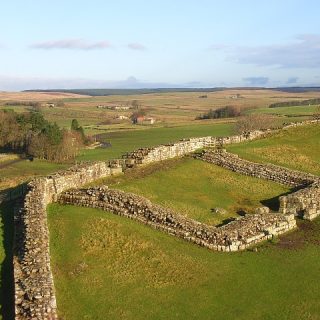
The construction of Hadrian’s Wall began in AD122. It measured 73 miles and ran from Segedunum at Wallsend, across the width of the country to Bowness on Solway in Cumbria. Each mile there was a gateway through the wall which could be found at a milecastle, which was effectively a small fortlet and equally spaced between each milescastle were two turrets.
Oldnall Road, a seemingly unremarkable two-mile rural stretch of B-road between the towns of Halesowen and Stourbridge in the West Midlands, hit the international headlines a few months ago (1) following reports of a series of sightings of an apparition. Reports of ‘road ghosts’ are nothing unusual, they form an important part of ‘ghost lore’ throughout the world (2).
Out of the dark, supernatural depths of Victorian England one name stands out. Jack.
Not Jack the Ripper, but a more supernatural fiend – Spring Heeled Jack!




Recent Comments